



This post may contain affiliate links. We may receive a small commission, if you make a purchase. Read Disclosure.
Even our guide got lost on our first night in Fes. We’d driven all day from the Sahara, it was dark, we were starving, and Mo was leading our group of women down lanes so narrow and twisty that Google Maps simply gave up on us. We found Restaurant Ouliya eventually, climbed to its rooftop, and looked out over the lights of the old city, a little giddy about what we’d see in the morning.
That was the first of three nights in Fes on the Morocco trip I led for Your Limitless Adventures in October 2026, and these are the things to do in Fes (or Fez, both spellings are right) that I’d send a friend to do. If you’re planning the whole route, our 10-day Morocco itinerary shows how Fes fits after the Sahara. This guide goes deeper into the medina, with more of what we did, where we ate, and how to get lost and found again without losing your cool (mostly).
What are the best things to do in Fes?
As of November 2026, the best things to do in Fes, Morocco are walking into Fes el-Bali through Bab Bou Jeloud, looking through the gates of Al-Qarawiyyin (founded around 857 to 859), standing above the Chouara tannery, watching potters and tile cutters at a ceramics workshop, and eating in a riad restaurant hidden behind a plain door. Two full days covers the Fez medina at a comfortable pace, and a third gives you time for a class or a cooking lesson.
Things to do in Fes at a glance
| Experience | Where | Time to allow | Good to know |
|---|---|---|---|
| Bab Bou Jeloud, the blue gate | West edge of Fes el-Bali | 15 minutes | Easiest meeting point in the medina |
| Getting lost in the Fes medina | Fes el-Bali | Half a day or more | Car-free, so you walk everywhere |
| Royal Palace gates | Place des Alaouites, Fes el-Jdid | 20 minutes | Outside only, the king’s residence |
| Borj Sud viewpoint | Hills south of the medina | 20 minutes | Best with a driver or taxi |
| Ceramics workshop and mosaic class | Mosaique et Poterie de Fes | 1 to 3 hours | Book the class ahead |
| Al-Qarawiyyin | Center of Fes el-Bali | 10 minutes | Non-Muslims look in from the gate |
| Chouara tannery and leather shops | Near Saffarin Madrasa | 45 minutes to an hour | Take the mint they hand you |
| Color Street | Off Talaa Kebira, near Café Clock | 30 minutes | Murals, small stalls, cafés |
| Rooftop drink | Mouda Palace | 1 hour | Few places serve alcohol |
| Cooking class | Palais Bab Sahra | An evening, dinner included | They’ll meet you at the blue gate |
A 2-day Fes itinerary (what we did)
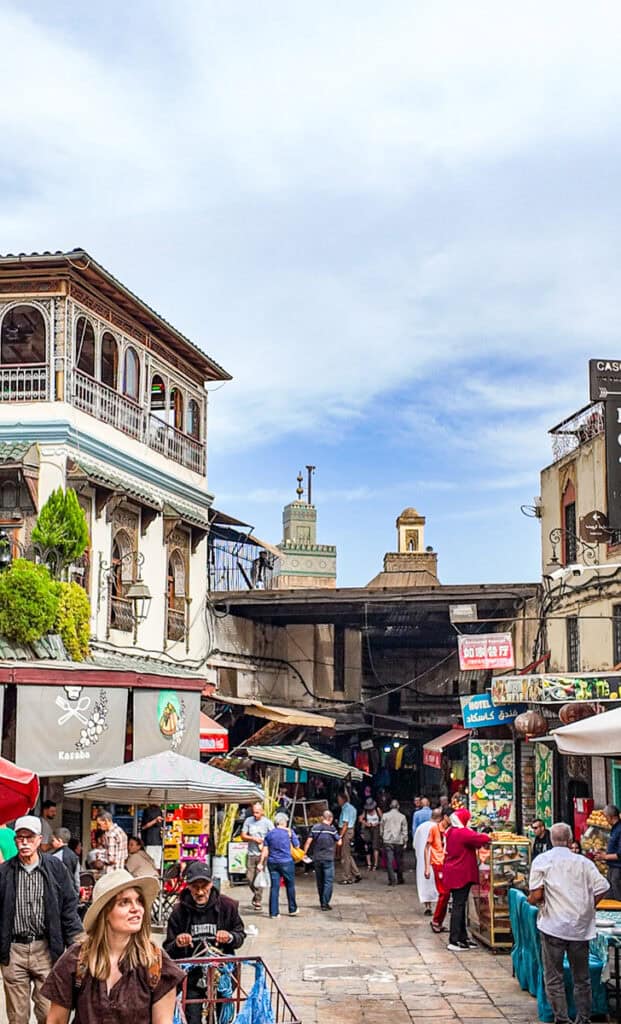
This is how our two full days in Fes ran, and I’d follow it again. Every stop has its own section below.
Arrival evening
- Dinner on the rooftop at Restaurant Ouliya, then check in at Dar Victoria.
Day 1: the city’s big sights, then a free afternoon
- Slow breakfast at Dar Victoria.
- Photos at the Royal Palace gates in Fes el-Jdid.
- The view over the medina from Borj Sud.
- A tour of the ceramics workshop, Mosaique et Poterie de Fes.
- Into the medina to peek through the gates of Al-Qarawiyyin.
- The Chouara tannery from a leather shop terrace, with time to try on jackets.
- Lunch at Restaurant Ryad Nejjarine.
- Free afternoon to get lost: coffee at Coffee Talaa, a wander down Color Street, and a drink on the rooftop at Mouda Palace.
- Taxi home and dinner at Dar Victoria.
Day 2: make something, eat well
- A mosaic and tile-painting class back at the ceramics workshop.
- Drop-off at Bab Bou Jeloud for free time.
- A long lunch on the rooftop at Café Clock.
- Shopping in the souks along Talaa Kebira.
- Cooking class and dinner at Palais Bab Sahra.
Departure day
- Early breakfast at Dar Victoria, then about three hours by road to Casablanca.
Walk into the Fes medina through Bab Bou Jeloud
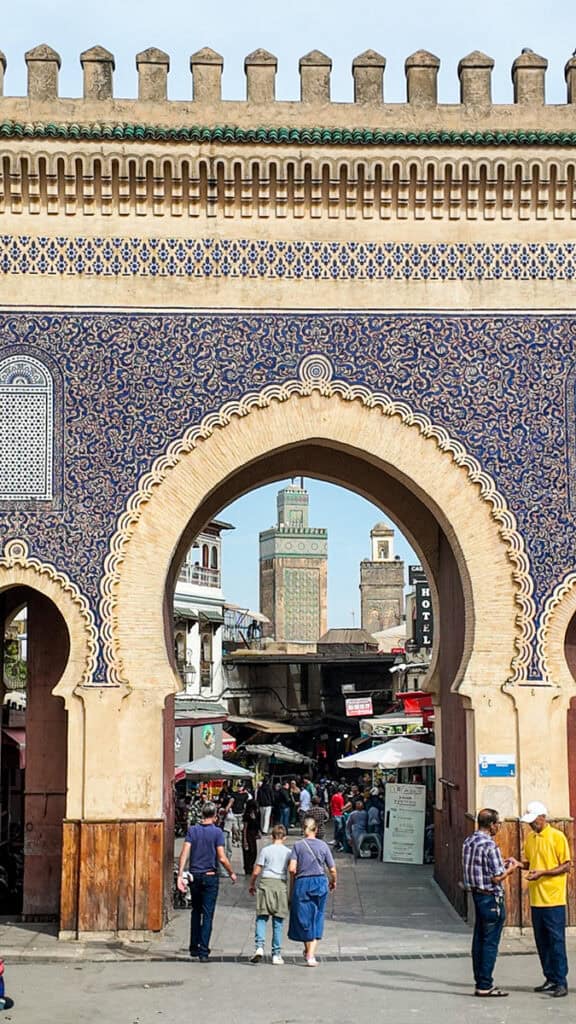
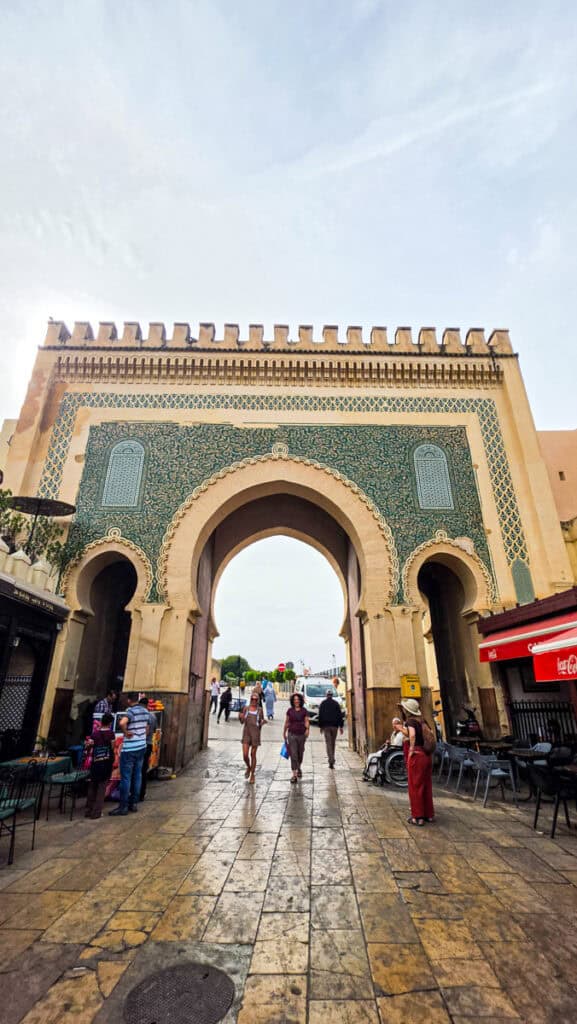
Bab Bou Jeloud is the grand tiled gate on the western edge of Fes el-Bali, and it’s where most visitors step into the old city for the first time. It’s tiled in blue on the outside and green on the inside, and if you stand back and look through the main arch, the minarets of the Bou Inania Madrasa and the Sidi Lazzaz Mosque line up inside it like a postcard.
The gate looks ancient, but Bab Bou Jeloud as you see it was finished in 1913, under the French Protectorate. A plainer, older gate (possibly from the 12th century) still stands just to the left of it, closed off now, and it was built with an angled passage so anyone entering had to come in sideways, a classic defensive trick.
Our driver dropped us here for free time on our last day, and it became our regrouping spot every time we split up. Talaa Kebira, the main lane of the souk, starts just inside, so this is the place to anchor yourself. Café Clock and Palais Bab Sahra are both a short walk in.
Get lost in the Fes medina (and find your way back)
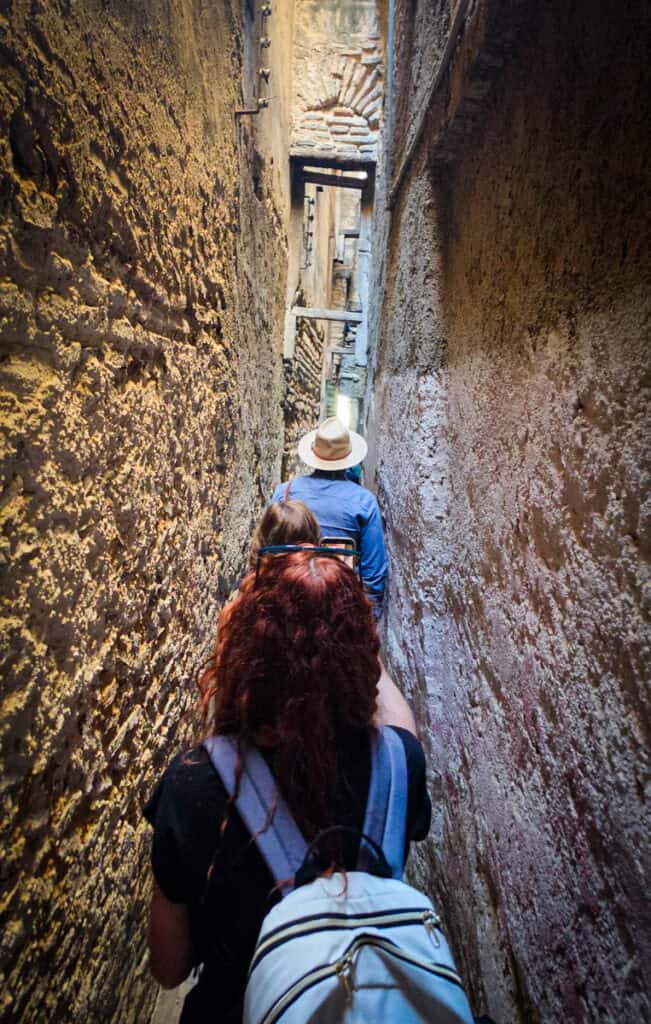
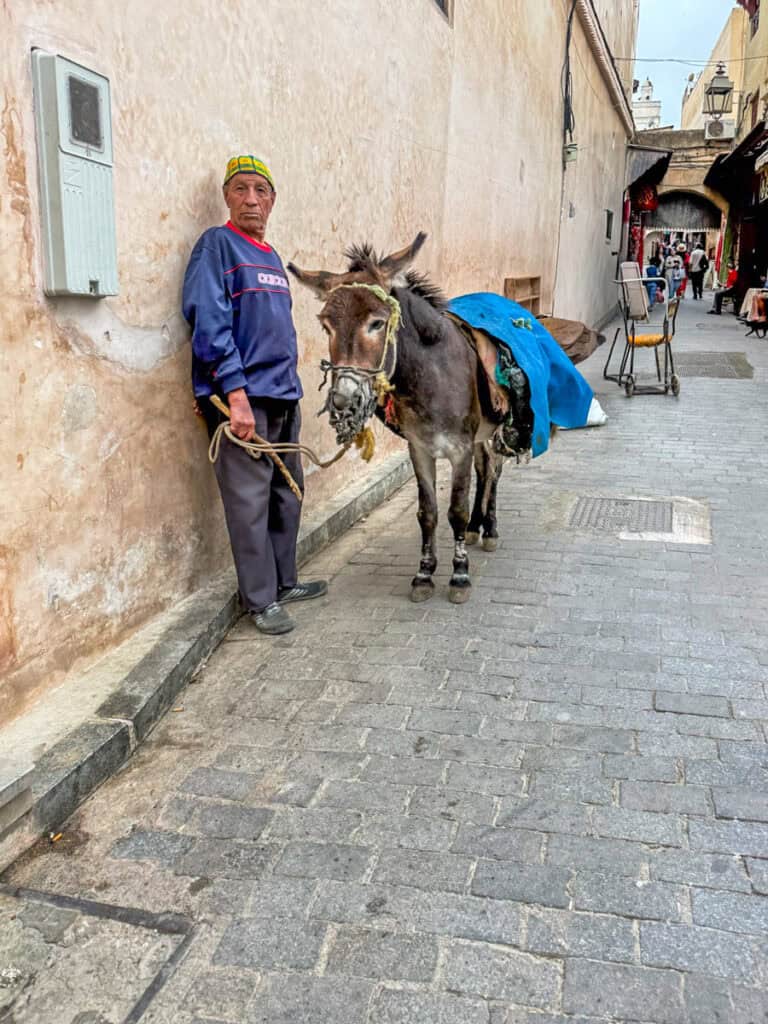
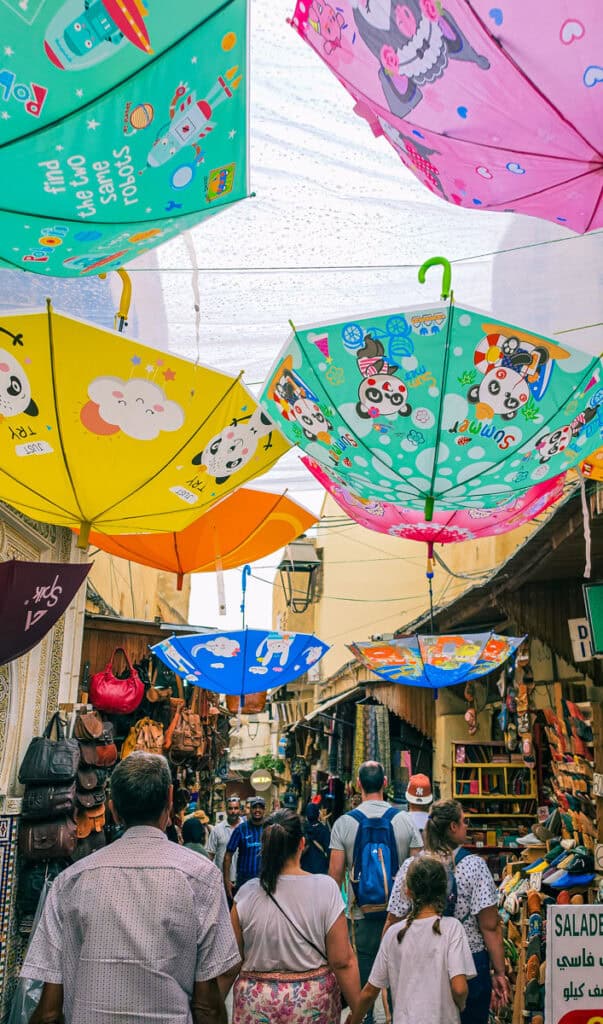
Fes el-Bali was founded in 789 as the Idrisid capital and is a UNESCO World Heritage Site, and it’s one of the largest car-free urban areas in the world. What that means on the ground is a tangle of lanes squeezed between high walls, many with nothing to buy and no sign to tell you where you are. I found it far harder to read than the souks in Marrakech, which felt open and busy by comparison.
On our first full afternoon I peeled off from Mo after an errand to find the rest of the group, and within minutes I’d hit two dead ends. There were stretches where I was the only person in the narrow, empty lanes, which set my heart racing a little, and then the medina spat me out into the main souk, hot, sweaty and pretty cranky (more on how that turned around below). I never felt unsafe, just a bit daunted, and every lost moment ended with a story.
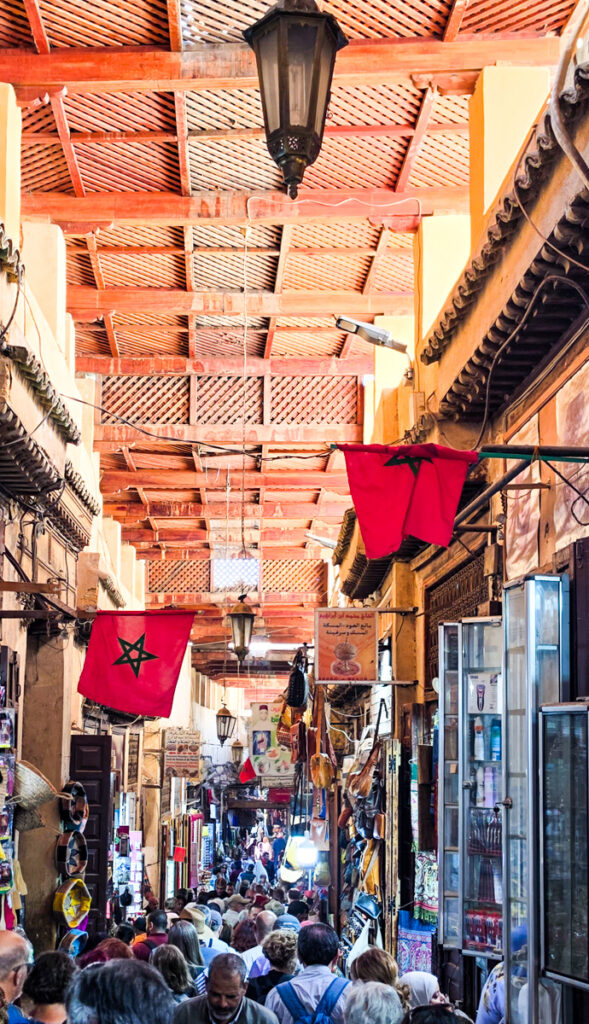
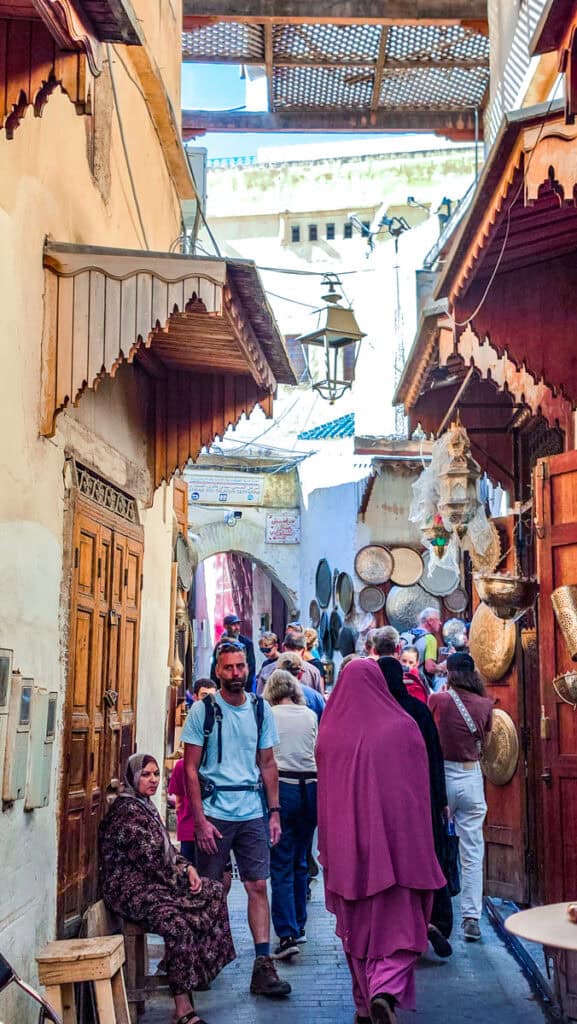
How to handle getting lost in the Fes medina:
- Learn two anchors before you go: Bab Bou Jeloud and Talaa Kebira. Most lanes you’ll want eventually feed back to one of them.
- Don’t rely on Google Maps. It lost Mo on our first night, and he lives in Morocco.
- Ask a shopkeeper for directions, rather than anyone who approaches you offering to lead the way.
- Save your riad’s phone number and a photo of its door. Some restaurants, like Palais Bab Sahra, will even send someone to fetch you from the blue gate.
- If you’re short on time, take a taxi to the nearest gate. We did this at the end of our first day so we wouldn’t miss dinner.
- Give yourself extra time for everything. A five-minute walk on the map can easily be 20.
See the Royal Palace gates in Fes el-Jdid
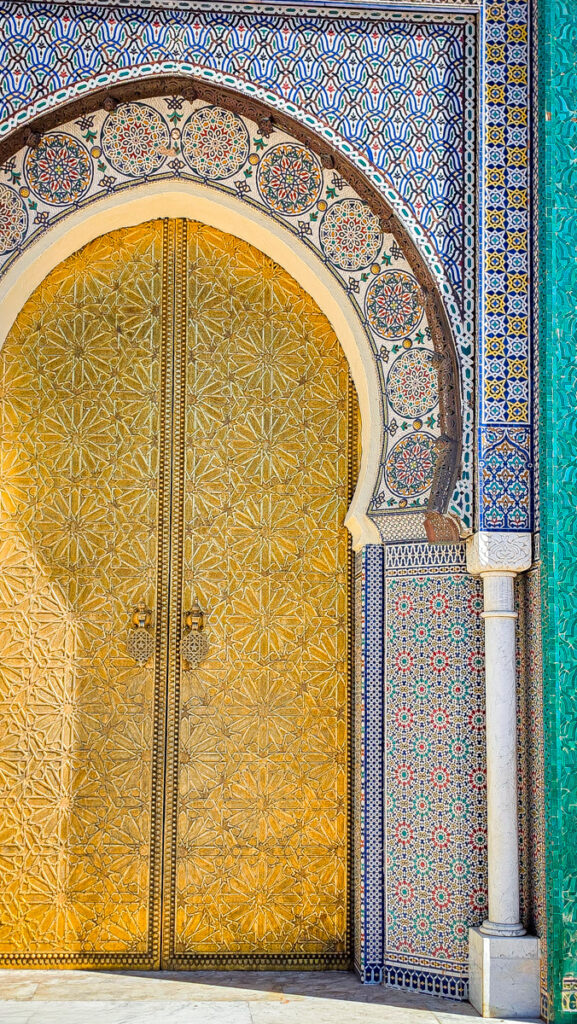
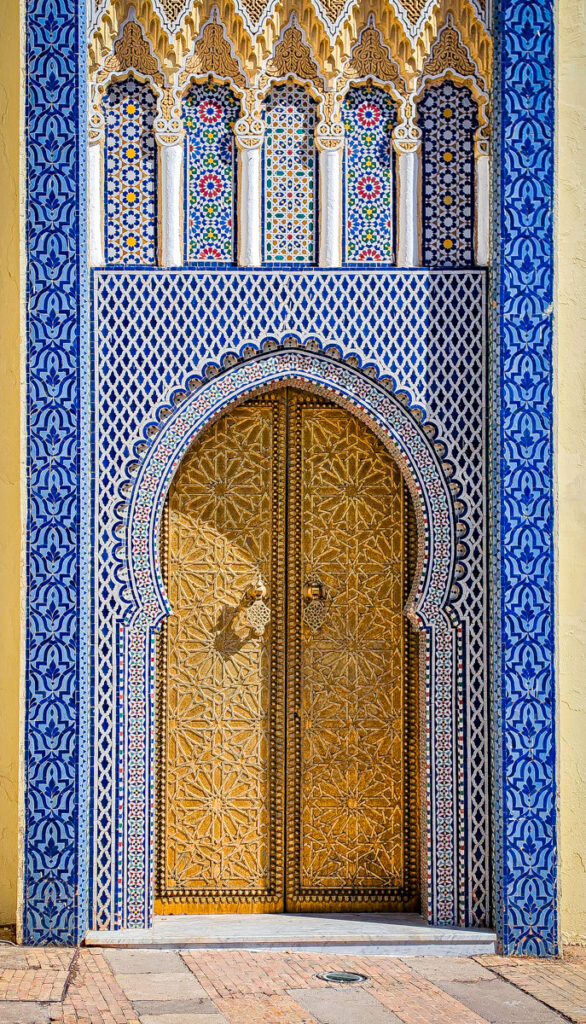
The Royal Palace of Fez, Dar al-Makhzen, is the King of Morocco’s palace in the city, and you can’t go inside (he uses it when he’s in Fes). What you come for is the ceremonial entrance on Place des Alaouites, a row of gilt bronze doors framed by zellige tilework and carved cedar, and it’s worth the stop on its own.
The palace itself dates to 1276, when the Marinid sultan Abu Yusuf Ya’qub built Fes el-Jdid, or “New Fez,” as a royal citadel beside the old city, and the grounds now cover about 80 hectares. The famous gates are much younger than they look, built between 1969 and 1971 under King Hassan II.
Mo started our first morning here. We stood in the square, took photos, and a couple of the women were happy to stay longer and get their shots just right. Twenty minutes is plenty, and it pairs easily with the Mellah, the old Jewish quarter next door, if you have time.
Look out over Fes from Borj Sud
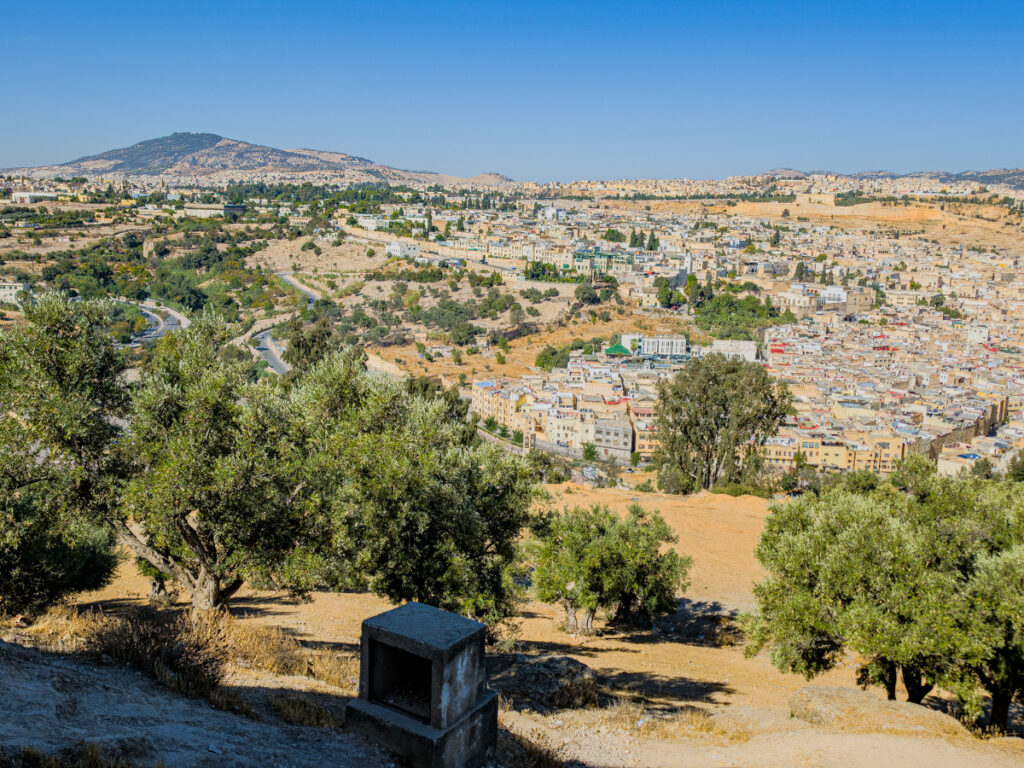
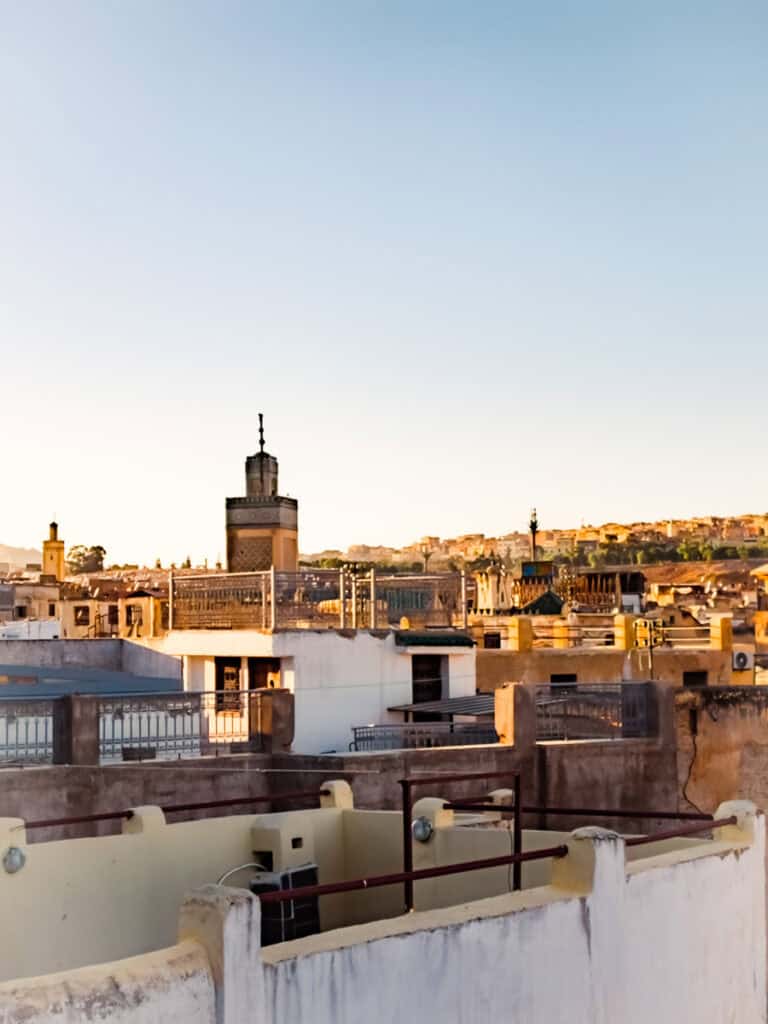
From the palace, Mo drove us up to Borj Sud, an old fortress on the hills south of the medina, and it’s the moment Fes made sense to me. The medina fills the valley below, a sea of rooftops inside its walls, with the mountains rising behind, and we could pick out the blue gate we’d walk through later that day.
Borj Sud was built around 1582 under the Saadian sultan Ahmad al-Mansour, and it faces its twin, Borj Nord, across the valley. Go with a driver or a taxi, since it sits uphill outside the walls, and go early or late in the day when the light is softer for photos.
Watch the potters at a Fes ceramics workshop
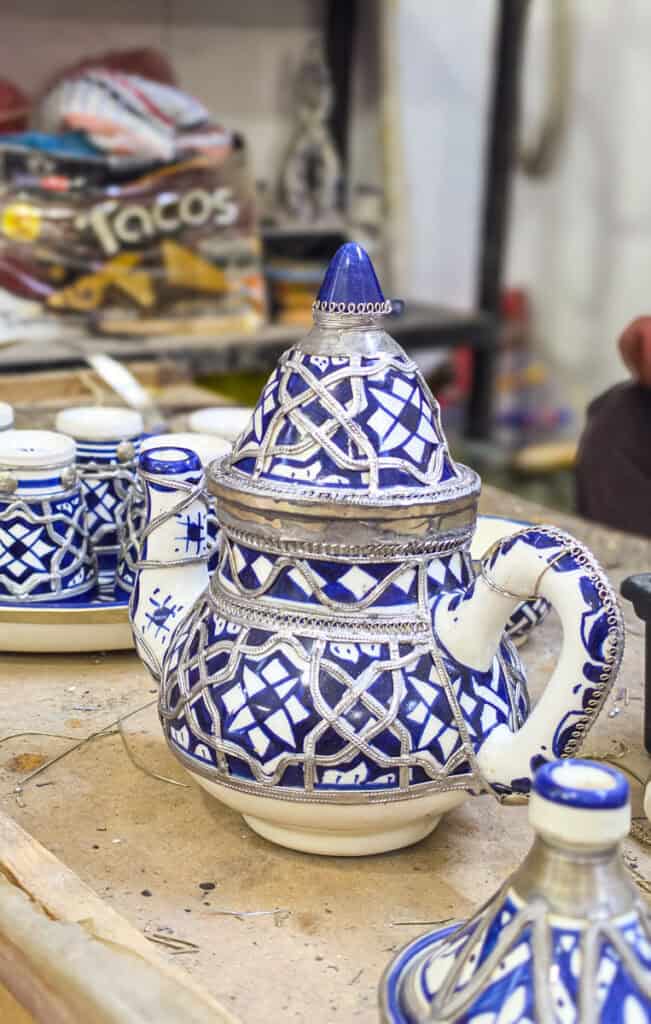
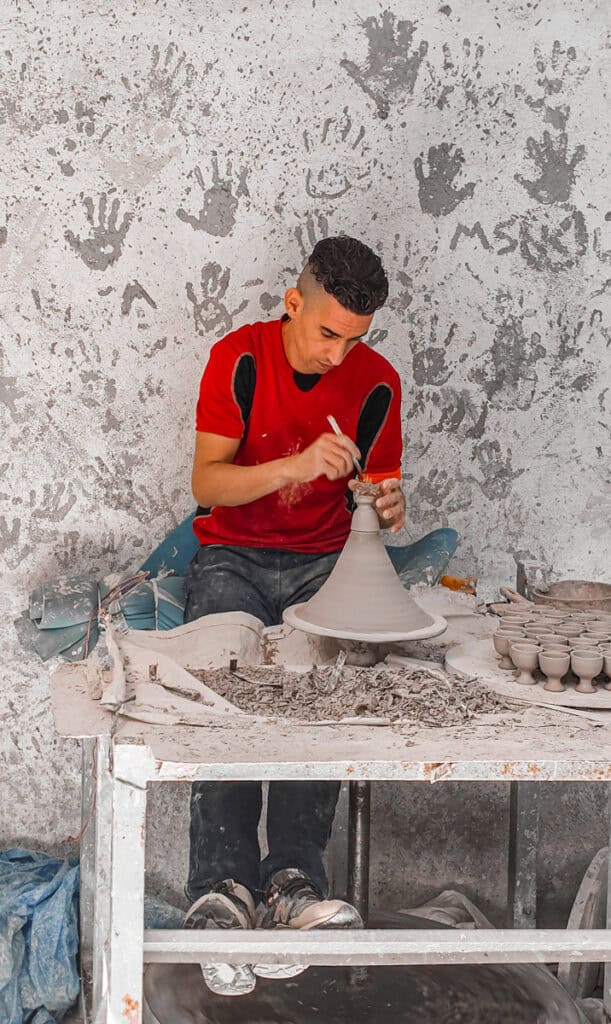
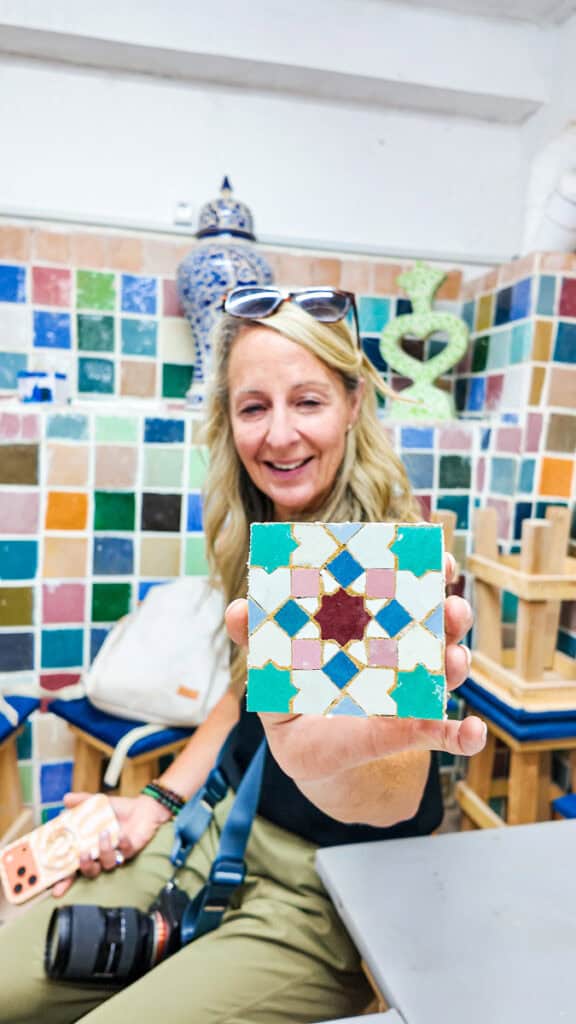
Fes has been famous for its pottery and zellige (geometric mosaic made from hand-cut pieces of glazed tile) for centuries, and you’ll see it on fountains, walls and tables all over the city. At Mosaique et Poterie de Fes, a ceramics workshop just outside the medina, we watched each stage of the craft: potters throwing on the wheel, cutters chipping tiny shapes for mosaics, and painters filling in designs by hand.
We had a short tour and then time to shop. Some of the women bought pieces for their homes, and I came away with a little dip bowl and egg cups for Craig, who takes his boiled eggs seriously.
Later, a few of the women found similar ceramics for less in the medina, so it’s worth knowing the trade-off. The workshop costs more, but you’ve watched the pieces being made and its ceramics are lead-free, which matters for anything you’ll eat or drink from, so I was happy to pay a bit extra. If you do buy in the souks, ask whether the glaze is lead-free before you haggle, especially for bowls and plates.
Make your own mosaic tile at a ceramics class
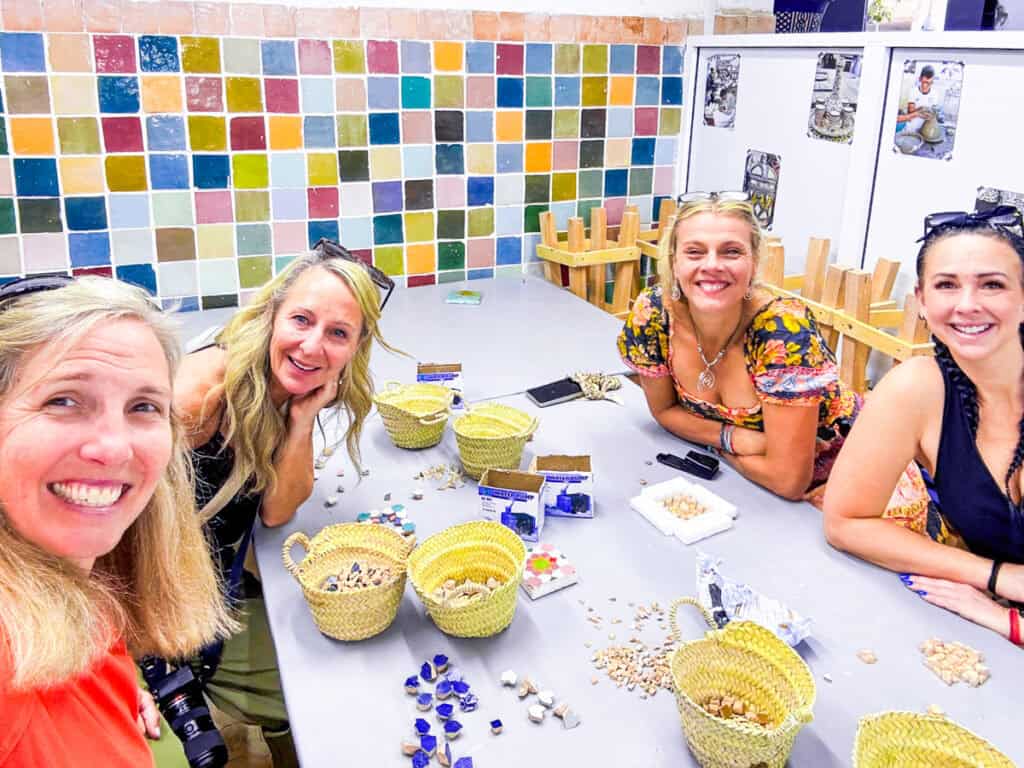
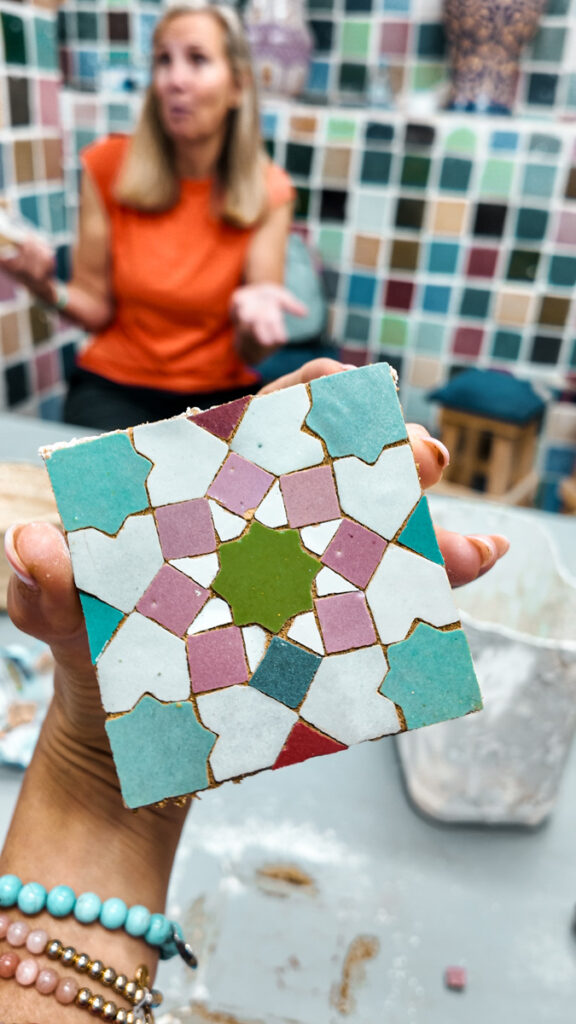
On our last morning we went back to the same workshop for a hands-on class, and it turned out to be one of the most relaxing hours of the whole trip. We each built a small mosaic from cut tiles, working from an example pattern (I did not trust my artistic talents enough to go rogue), and when I flipped mine over I discovered I’d picked slightly mismatched colors without noticing. It’s a little unorthodox, but it holds together, which feels about right for me.
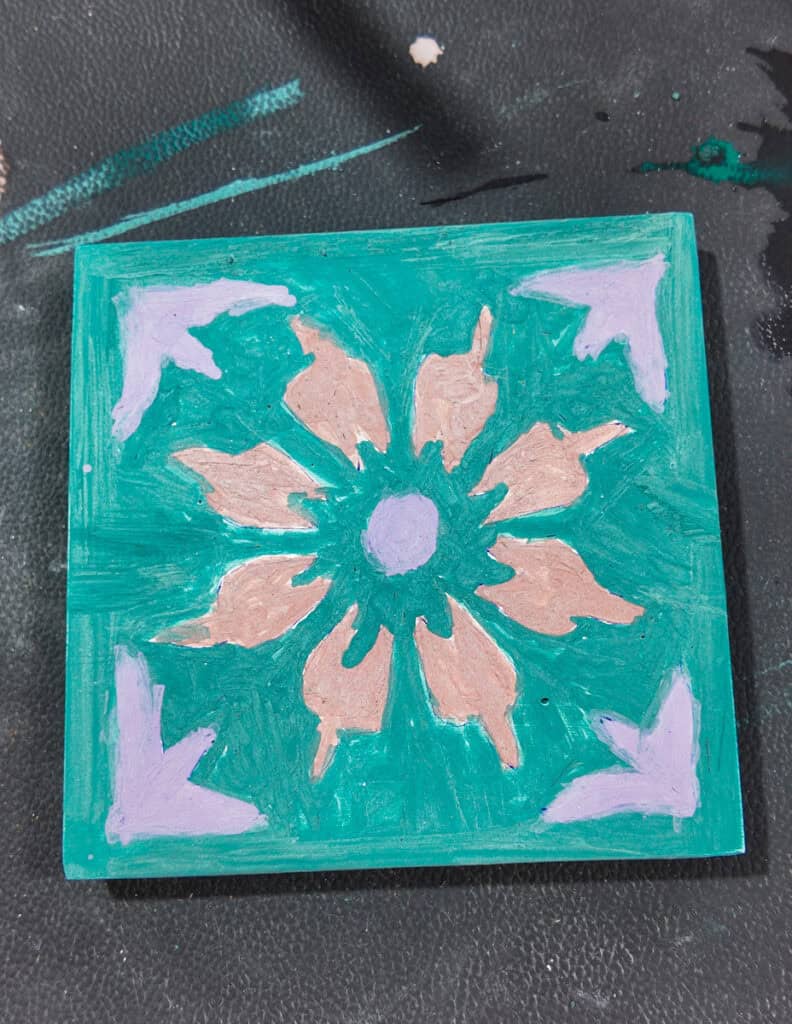
Then we painted a stenciled tile. Mine was a lotus flower, and I’m a messy painter, but I loved the colors I chose. The painted tiles can’t be fired or glazed in time for you to take them home, so expect the paint to wear eventually.
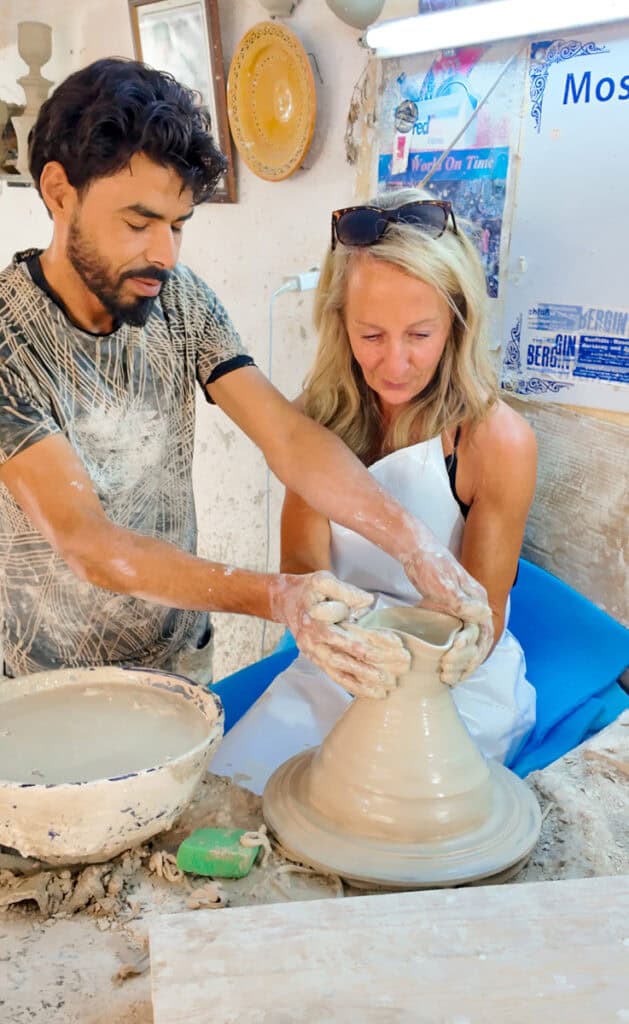
A few of the women also sat down at the potter’s wheel with one of the craftsmen and spun plates and a heart-shaped tray. You can’t keep the wheel pieces, since there’s no time to dry and fire them, and the women loved the feel of the wet clay anyway (a couple said they want to try pottery back home). You can book a similar pottery and mosaic class here.
Peek into Al-Qarawiyyin, the world’s oldest university
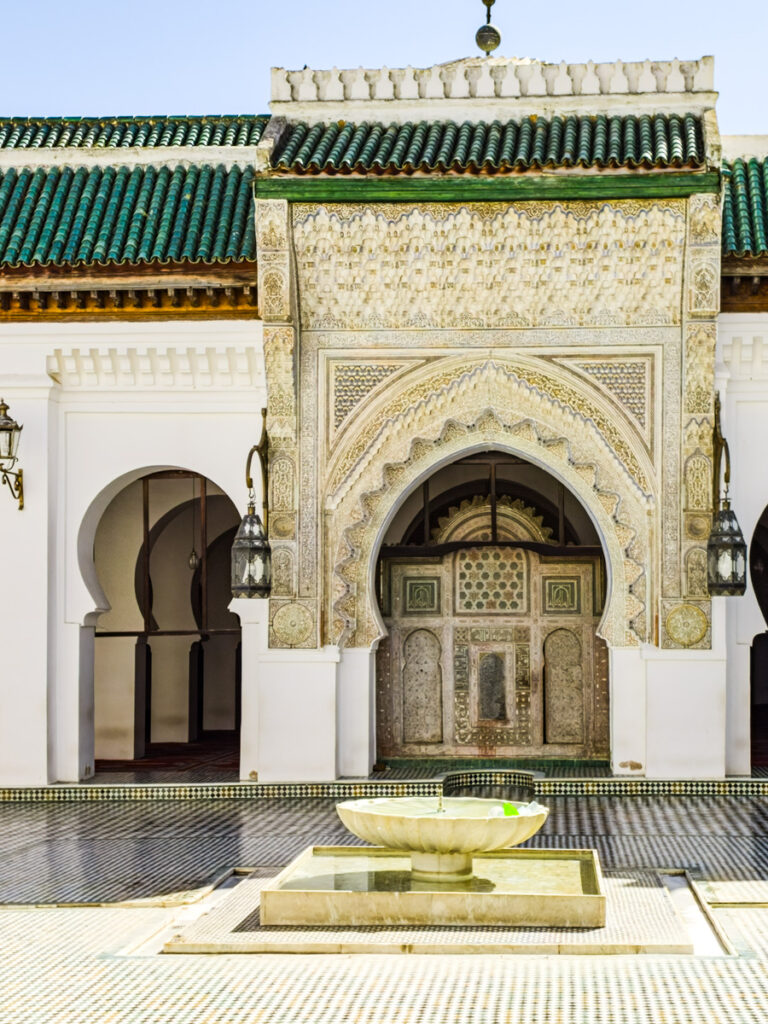
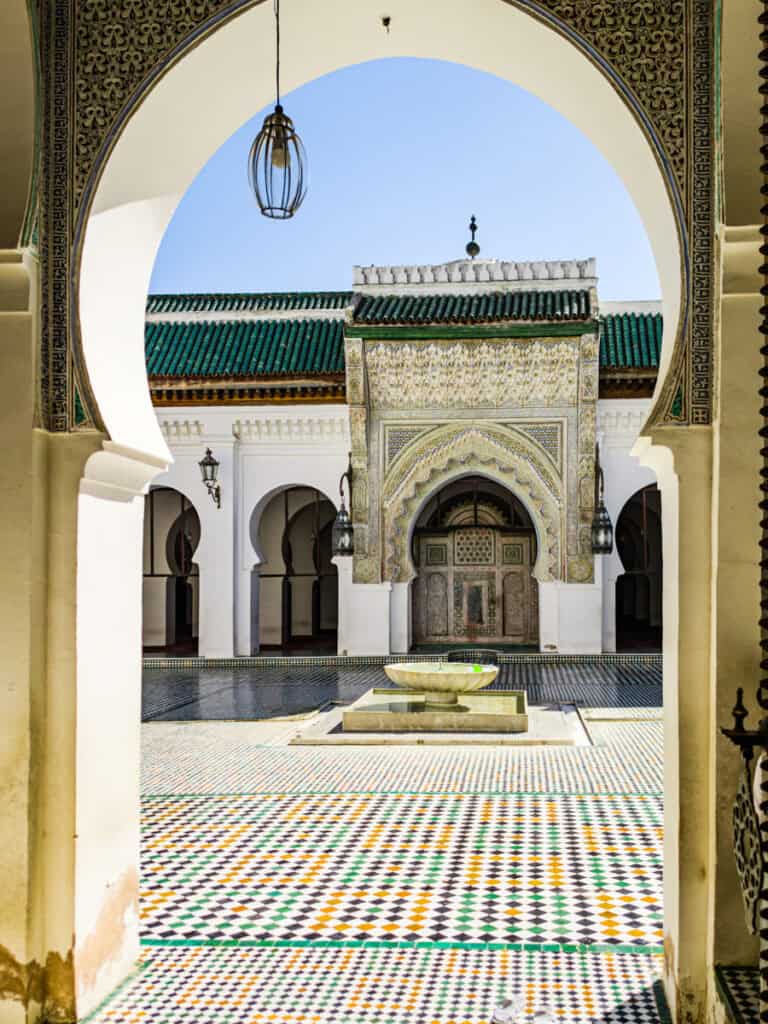
Al-Qarawiyyin began as a mosque, founded by tradition around 857 to 859 by Fatima al-Fihri, the daughter of a wealthy merchant who had settled in Fes. Guinness World Records lists it as the oldest existing, continually operating educational institution in the world, and UNESCO calls it the oldest university in the world. Historians still debate the exact date (a foundation inscription found during 20th-century renovations points to 877), but either way, people have been studying here for well over a thousand years.
Its library, founded in 1349 by the Marinid sultan Abu Inan Faris, is often described as one of the oldest libraries still in use.
Non-Muslims can’t go inside the mosque, so we did what everyone does and peeked through the open gates into the courtyard, all carved arches and tilework. It takes ten minutes, it’s free, and it sits right in the thick of the souks, so you’ll likely pass it while you wander.
Stand above the Chouara tannery in Fes
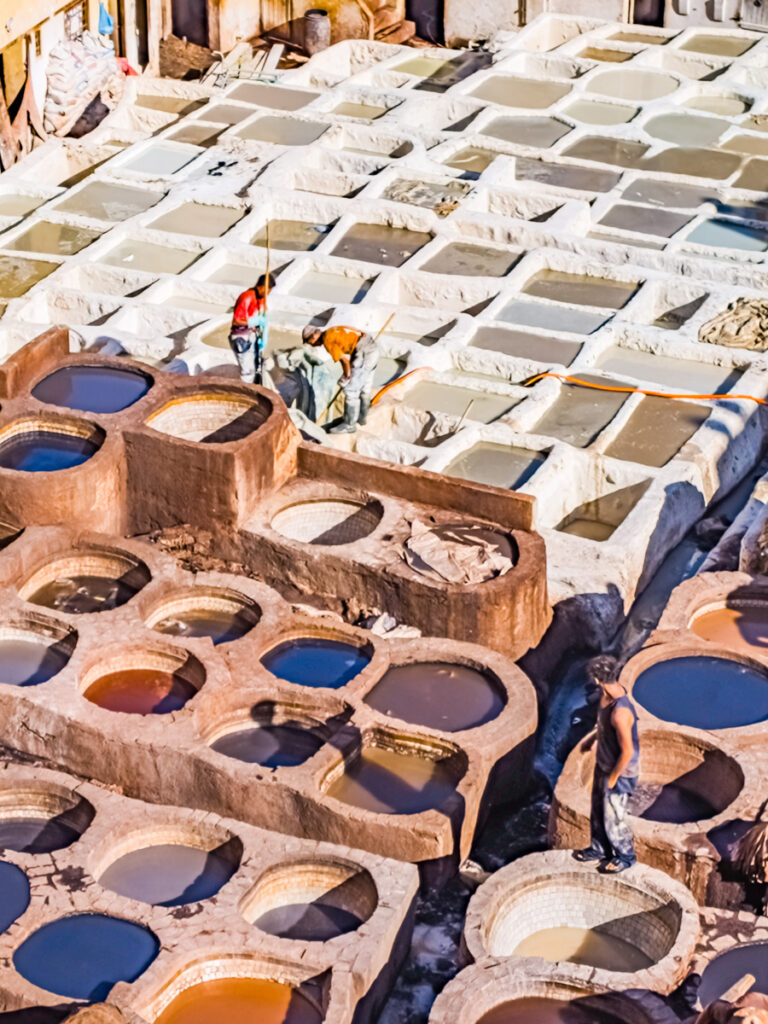
The Chouara tannery is the largest of the three tanneries in Fes and one of the oldest, a honeycomb of round stone vats beside the Oued Fes near the Saffarin Madrasa. Local tradition says it dates back to the city’s founding by Idris II in the early 9th century. Historians aren’t sure of its exact age, but the work here has barely changed since medieval times.
The hides (cow, sheep, goat and camel) soak for two to three days in a white mix of cow urine, pigeon droppings, quicklime, salt and water to soften them, which goes a long way to explaining the smell. Then they move into vats of natural dyes, with poppy for red, indigo for blue and henna for orange, before drying in the sun. All of it is done by hand.
You watch from the balconies and terraces of the leather shops that surround the tannery. As we walked in, someone handed each of us a bunch of fresh mint to hold under our noses, and believe me, you’ll use it. The stench is powerful, and the view is extraordinary, so take the mint and stay a while.
Shop for leather near the Chouara tannery
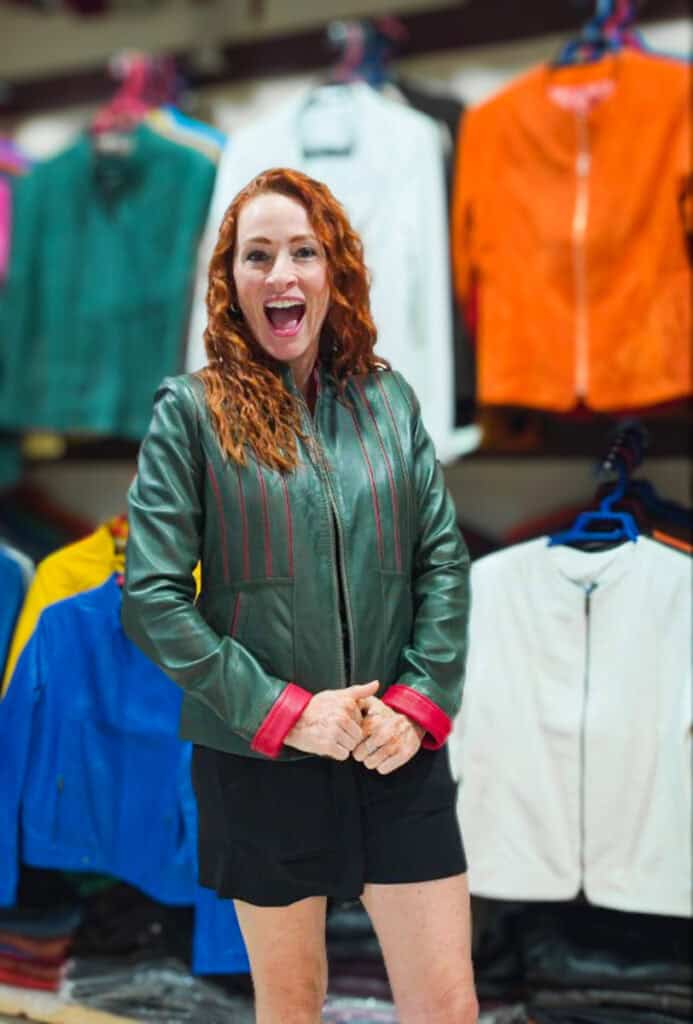
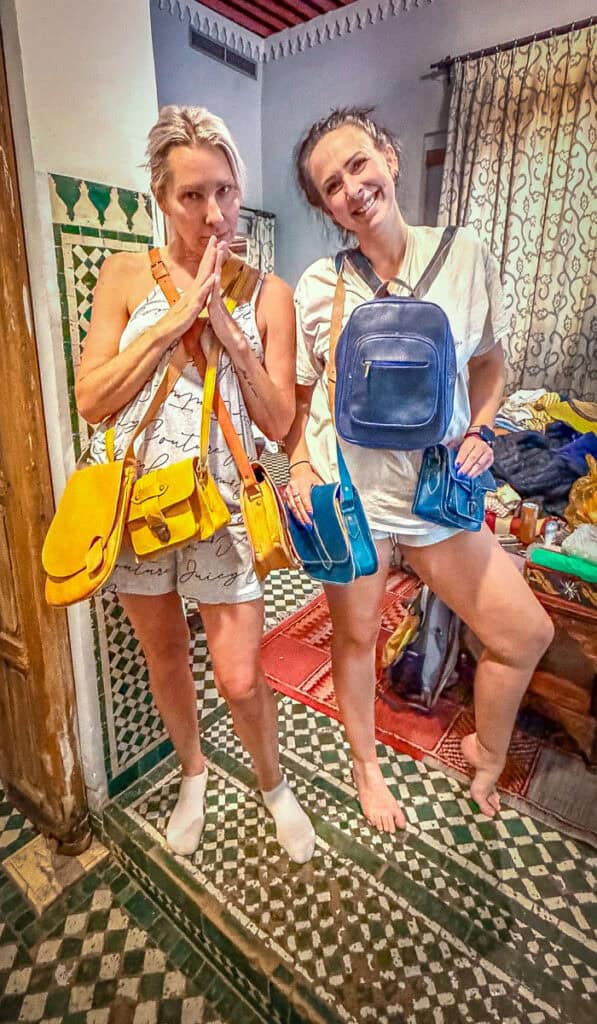
Fes is known for its leather, and the shops around Chouara sell all kinds of it, from jackets to bags. The leather we touched was incredibly soft, and the shop whose terrace we watched the tannery from could make a jacket to measure, which one of our group did.
A few of the women tried on jackets and bartered with one of the salesmen, who was so funny and gracious that he ended up joining in when we broke into one of our silly Moroccan dances for a reel. Watching them shop was half the fun. I didn’t buy anything (my bank account was looking very dry by then), and I regretted it the moment I saw the soft leather handbags the others carried home.
Tips for buying leather in Fes:
- Open at about a third of the asking price and expect to settle somewhere near half.
- Ask whether made-to-measure is possible if you love a style but not the fit and allow time for it before you leave Fes. One of the ladies on our trip had a leather jacket custom made and it was delivered to our riad later that evening!
- Leave room in your suitcase, or plan to buy a cheap extra bag in the souks to carry it all home.
Find a locals’ coffee shop in the Fes medina
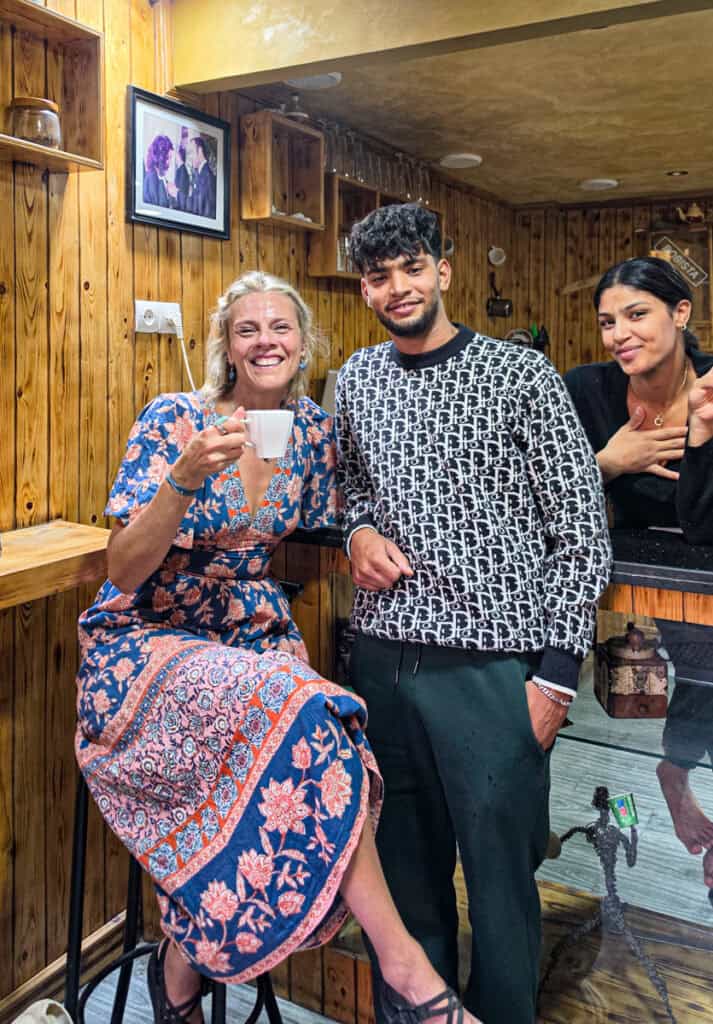
Remember me, hot, sweaty and cranky in the souk? I desperately needed coffee, and I ducked into Coffee Talaa, a tiny café in a quiet lane just off the main market. I must have looked like a hot mess, because the owner handed me a bottle of water before I’d even ordered and told me it came free with the coffee. Prices were wonderfully cheap, and he explained this was a coffee shop for locals more than tourists, which is when I knew I’d struck gold.
The cappuccino was good, and the conversation was better. He started sharing little thoughts on kindness and unity, I slowly felt my shoulders drop, and then he told me he was a spiritual coach who helps people turn negative energy into positive. I’d walked in carrying a whole cloud of negative energy, and I walked out light and happy, which is exactly why I travel. His two staff asked for a photo with me and asked me to share their café, and I told them I was already planning to.
I can’t promise you’ll meet a spiritual coach, but do step off Talaa Kebira and find a small café where locals are drinking. The coffee in Morocco surprised me, from spiced traditional coffee to proper espresso, and a quiet lane is the best antidote to the medina’s noise.
Walk Color Street, the painted lane
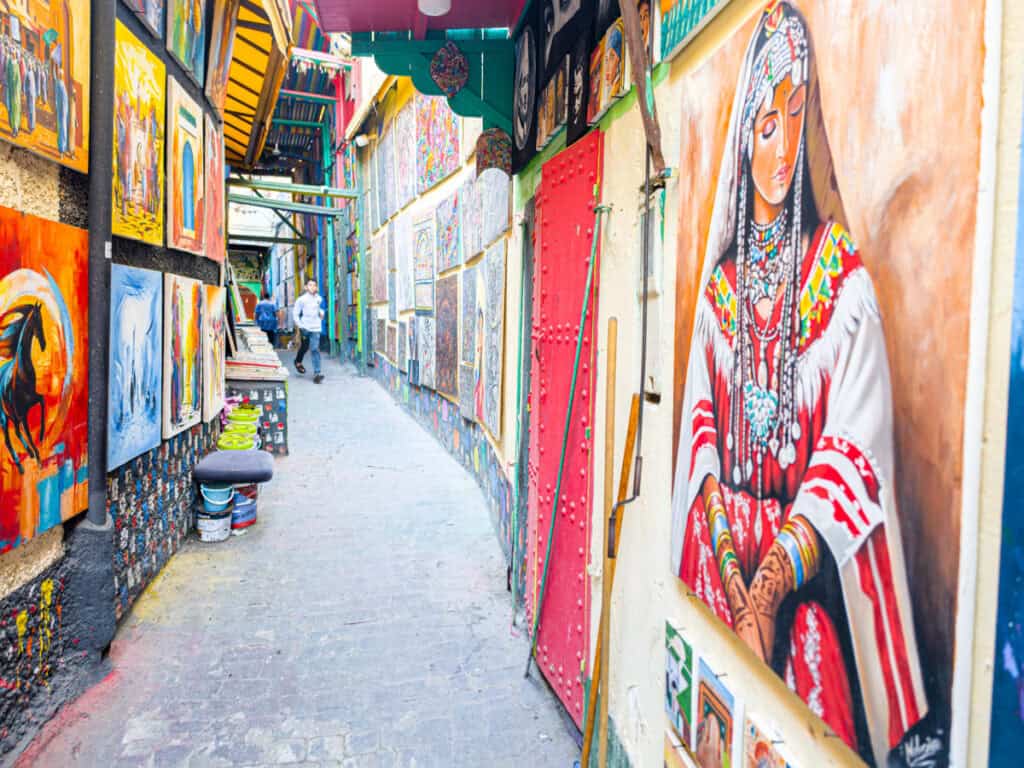
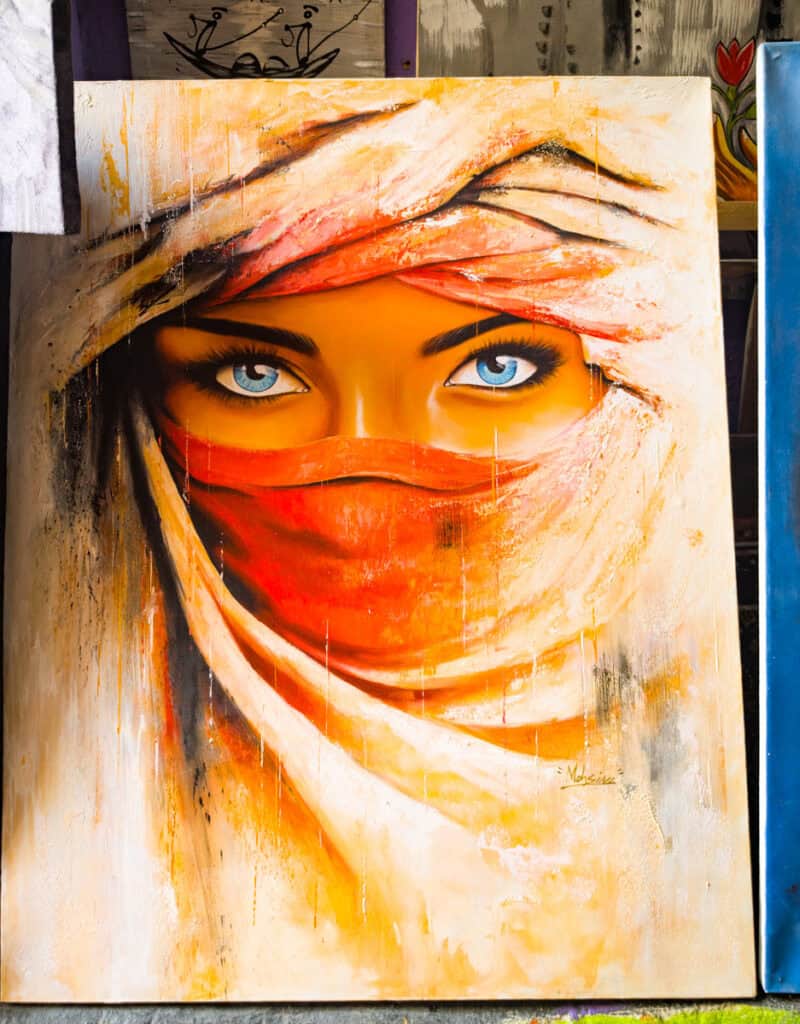
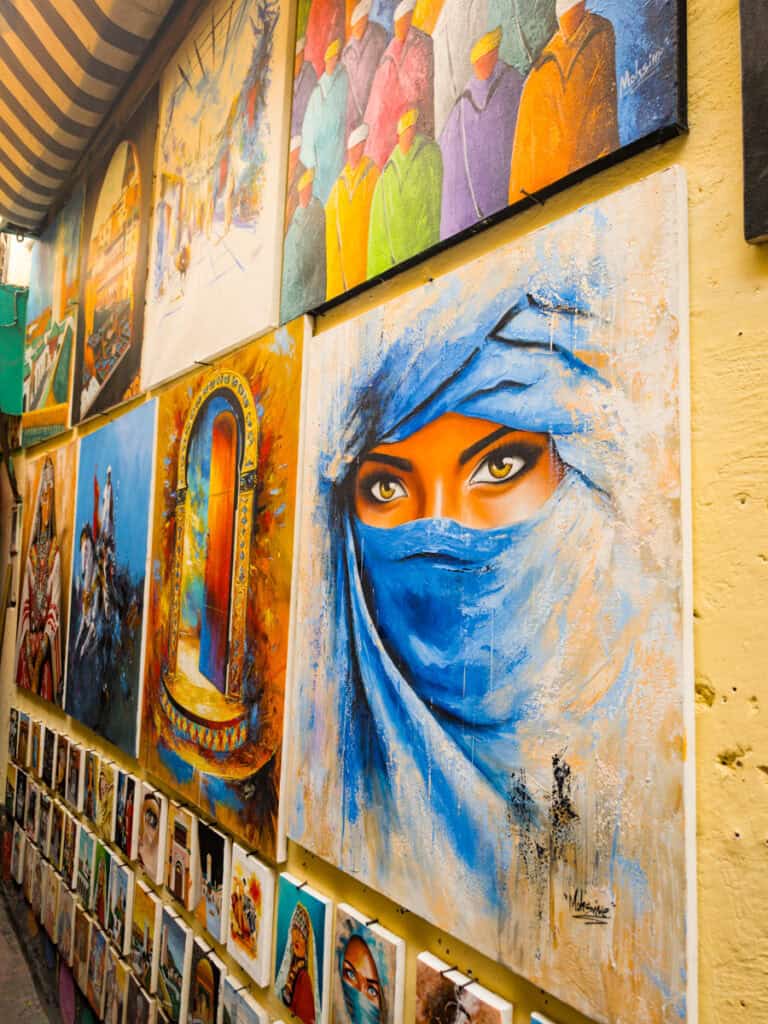
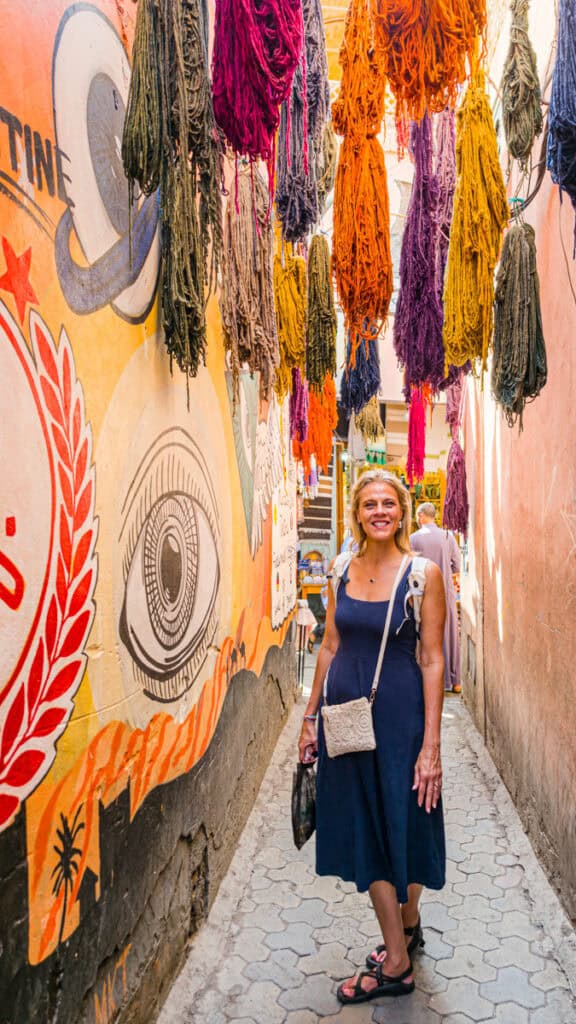
Not long after my coffee, I wandered into a narrow lane covered in bright, colorful paintings and portraits, and it became my favorite part of the Fes medina. There’s not too much else to it, just a pretty narrow alley connecting the two main streets of the souks.
Color Street is marked by that name on Google Maps, and it sits close to Café Clock, so pair the two. Bring your camera.
Watch out for the fake coffee-shop scam
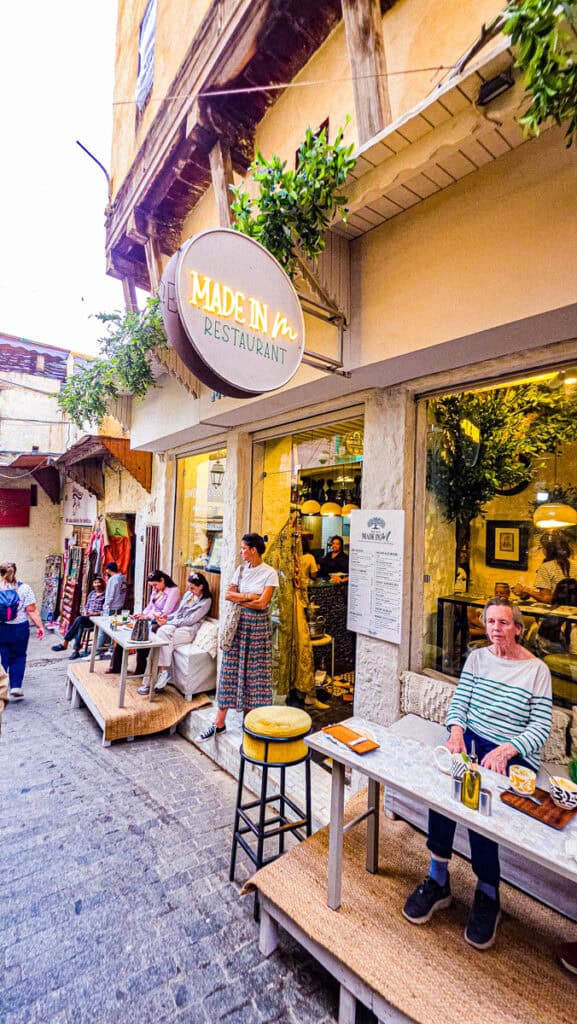
In the painted lane I bumped into a few of the women from our group (in a medina this size, the odds felt like a small miracle), and they had a story. A man had offered to lead them to a coffee shop, taken their money for his trouble, and the coffee shop didn’t exist.
Scams like this happen in every country, and they laughed it off and called it a lesson in being too trusting. They were great sports about it. To avoid it, say a polite no thanks to anyone who offers to walk you somewhere, ask a shopkeeper for directions instead, and use a guide you’ve booked ahead if you want help finding your way.
Have a rooftop drink at Mouda Palace
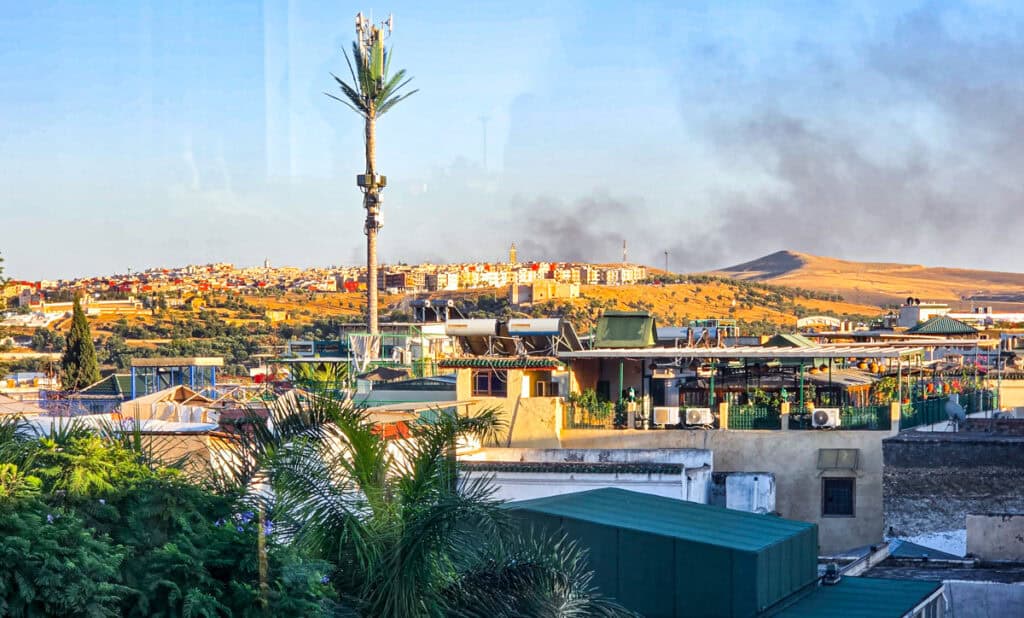
The women were ready for a drink, and they’d heard about a rooftop, so I tagged along. Mouda Palace was another classic Fes surprise, an ordinary-looking alley that opened into a beautiful palace and then a rooftop with views across the medina. It was relaxing to sit up there, laughing and chatting as the afternoon wound down, and the food menu looked terrific (we didn’t eat, and I wish we had).
The cocktail menu was out of Aperol the day we visited, so I settled for a limoncello spritz, which I didn’t love. A few of the others ordered Moroccan wine, so I joined them with a glass of white, and it was very good, every bit as nice as the reds we’d tried around the country.
Finding alcohol in Fes
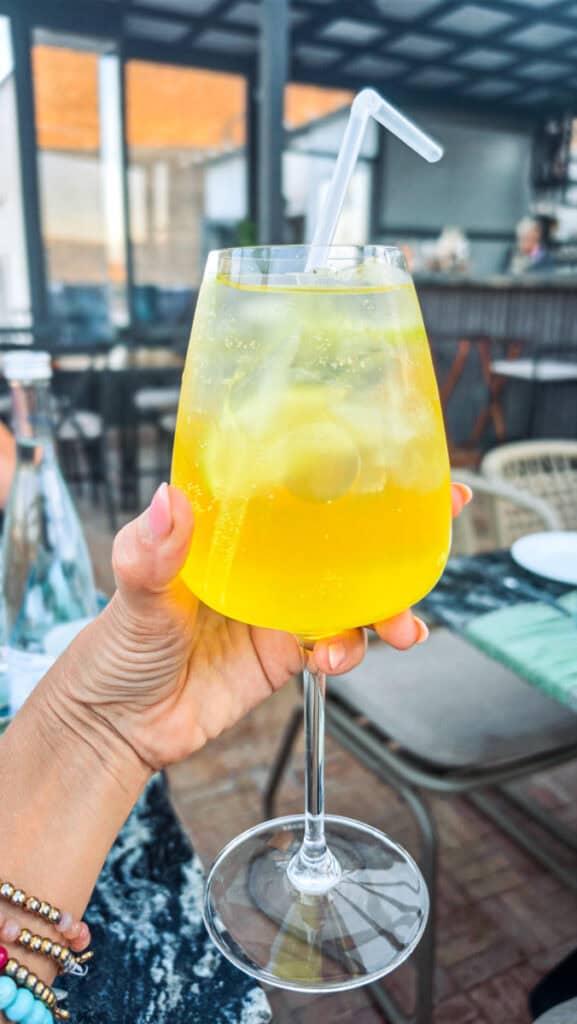
Not many places in Fes serve alcohol, so look up bars and licensed restaurants before you go if a glass of wine at sunset matters to you. Many riad restaurants in the medina don’t serve it at all.
On our trip, Mo stopped at a liquor store earlier in the drive so we could buy Moroccan wine, and our riad in Fes let us bring a bottle to dinner for a corkage fee. I paid about $12 a bottle, and it was smooth and lovely.
Take a taxi back (and maybe get a marriage proposal)
We were running late for dinner, so we skipped another round of getting lost and grabbed a taxi back to our riad. Our driver was an absolute hoot. He asked me how many camels my dowry would be if we were to marry, and I said four, thinking I’d driven a hard bargain. He said, “Oh my goodness, no, not for you. It should be four thousand.”
That was a glaring reminder of how much I undervalue myself, and it’s how I left Fes with a marriage proposal and four thousand camels.
Take a cooking class at Palais Bab Sahra in Fes
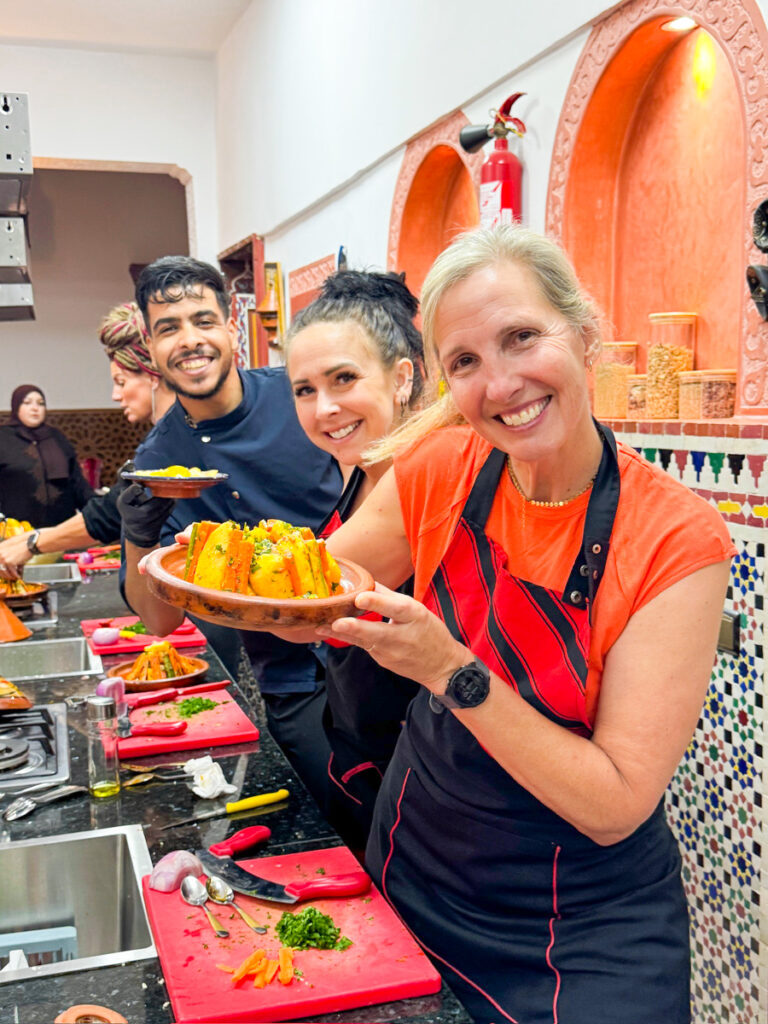
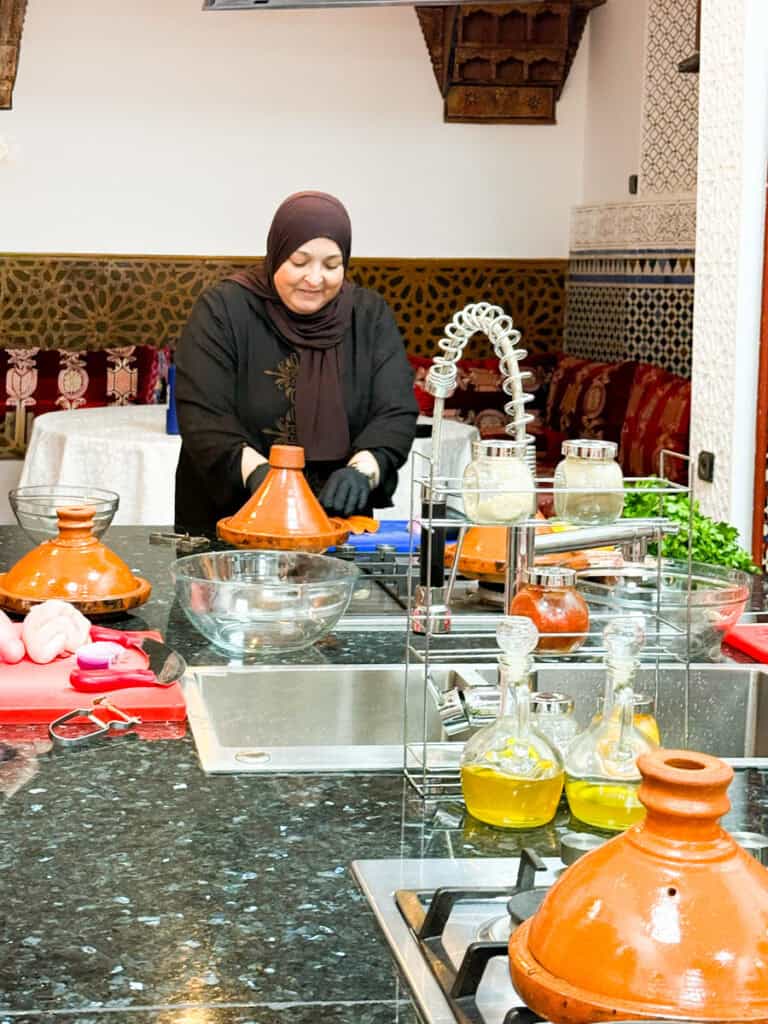
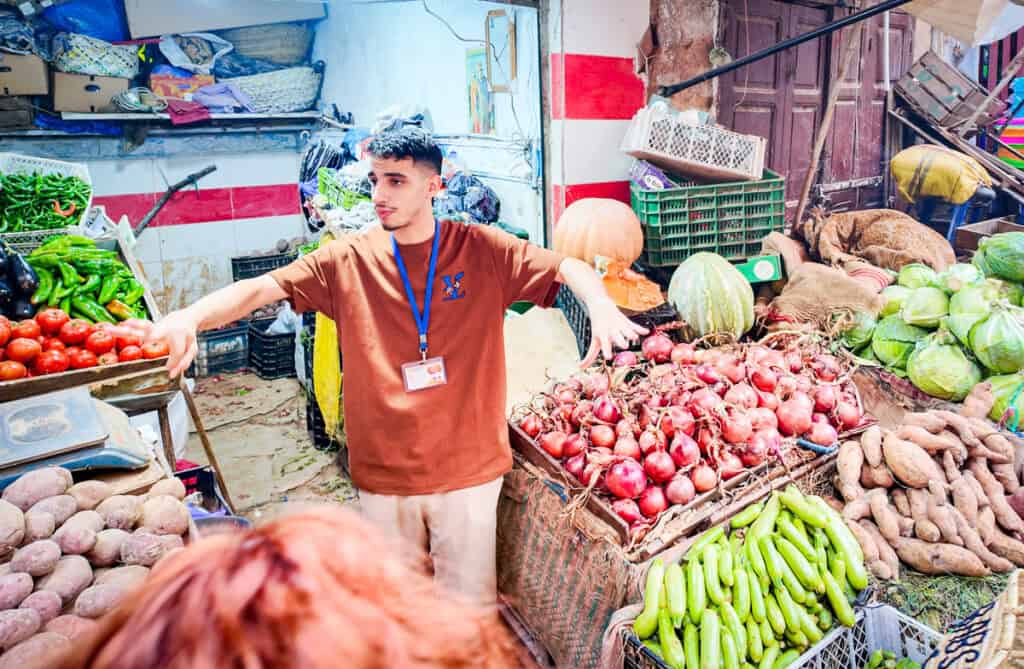
Our last evening together was a cooking class and dinner at Palais Bab Sahra, a restaurant and riad at 25 Derb Tariana, off Talaa Kebira, about 50 meters inside the blue gate. Like everywhere in Fez, getting there involved a couple of wrong turns down back alleys, and then a plain door opened into soaring ceilings and palace-style rooms. If you’re worried about finding it, they’ll collect you from Bab Bou Jeloud or Batha Square if you call ahead.
We started our class by visiting the markets outside and shopping for our ingredients. I liked this aspect of the class as it brought in the reality of life for locals. And I love knowing that my food came from produce purchased a few steps away.
We climbed to a small cooking room near the top of the building, where a chef and her team of sous chefs walked us through a chicken tagine, step by step. It’s simpler than I expected. Tagine is the name of the cone-lidded clay pot as much as the dish, the meat and vegetables come out wonderfully tender, and the trick is all in the balance of spices. While it cooked, we had mint tea and cookies on the rooftop terrace, with views across the city.
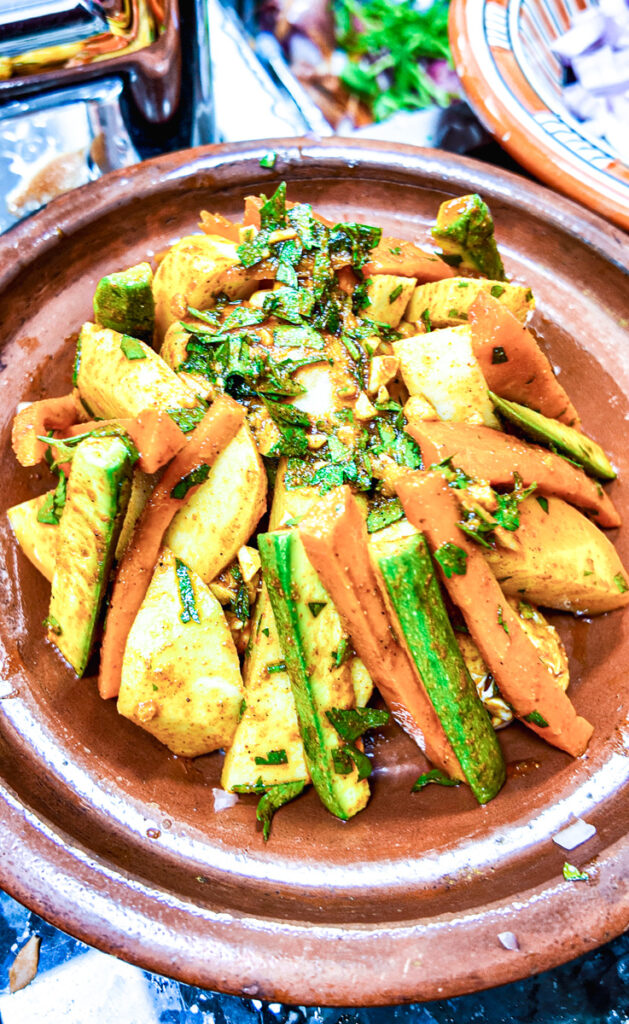
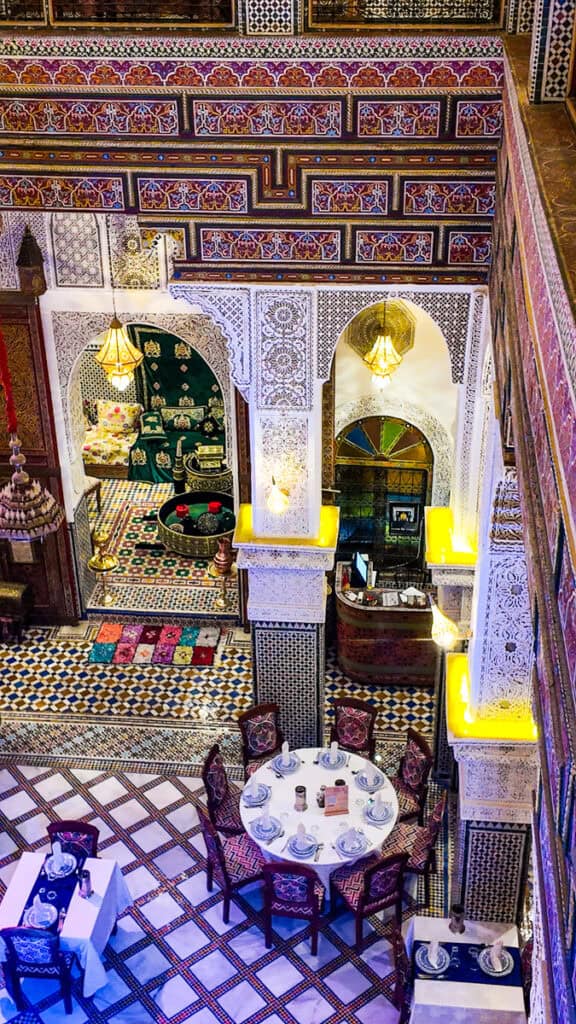
There was a lot of laughing, a bit of showing off and, of course, some dancing. Then we sat down in the restaurant to eat what we’d made, after a spread of Moroccan salads and before a plate of fruit, which is how most meals in Morocco end. The bar is made from the same fossil-packed stone we’d seen two days earlier at Pierre d’Erfoud, and it was fun to recognize it.
Palais Bab Sahra also runs bread-baking, patisserie, calligraphy and henna workshops, if you’d rather try something else. I don’t own a tagine pot, but I’d love to make this at home, because the flavor is so good.
You can book the cooking class through the Palais Bab Sahra website or look at another Fes cooking class option here.
Eat lunch on the rooftop at Café Clock
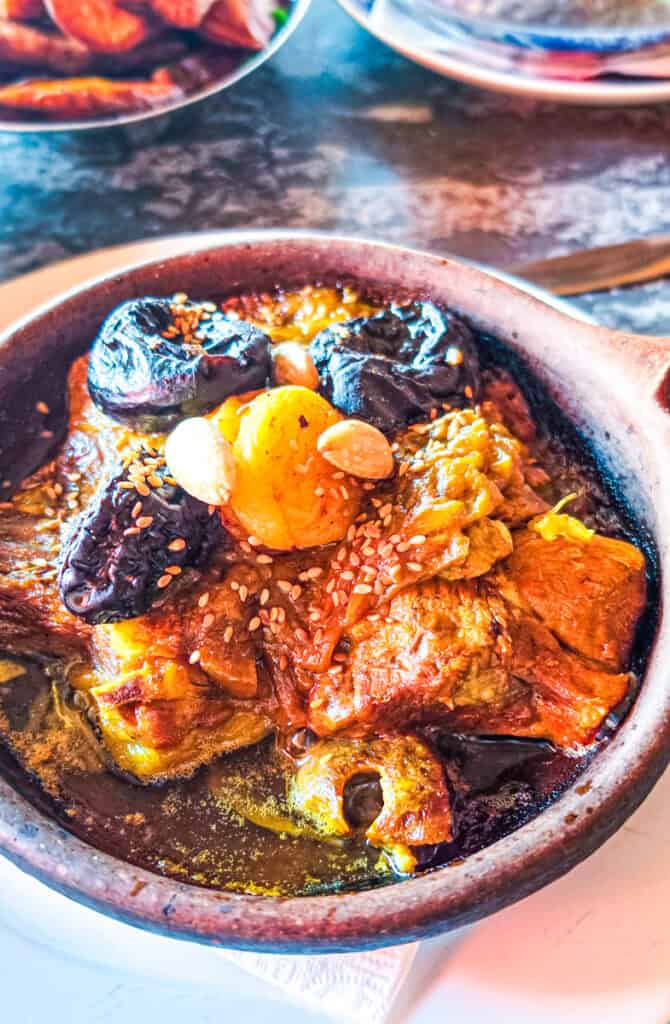
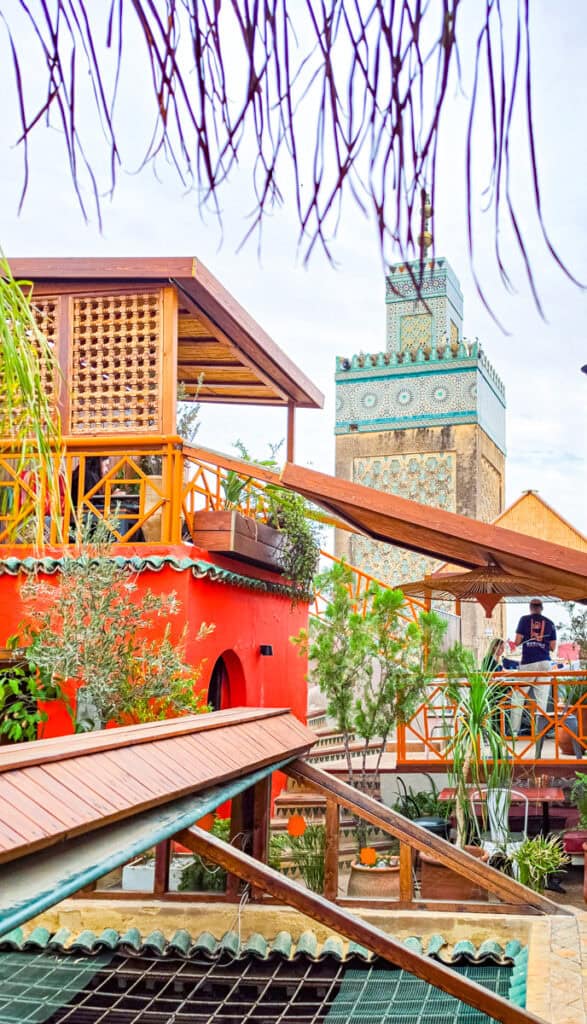
Café Clock was my favorite meal in Fes and probably my favorite in all of Morocco. It’s at 7 Derb el Magana, a short lane off Talaa Kebira near the blue gate, in an old house spread over several levels, and it was started by Mike Richardson as a cultural café with live music every night and hands-on workshops.
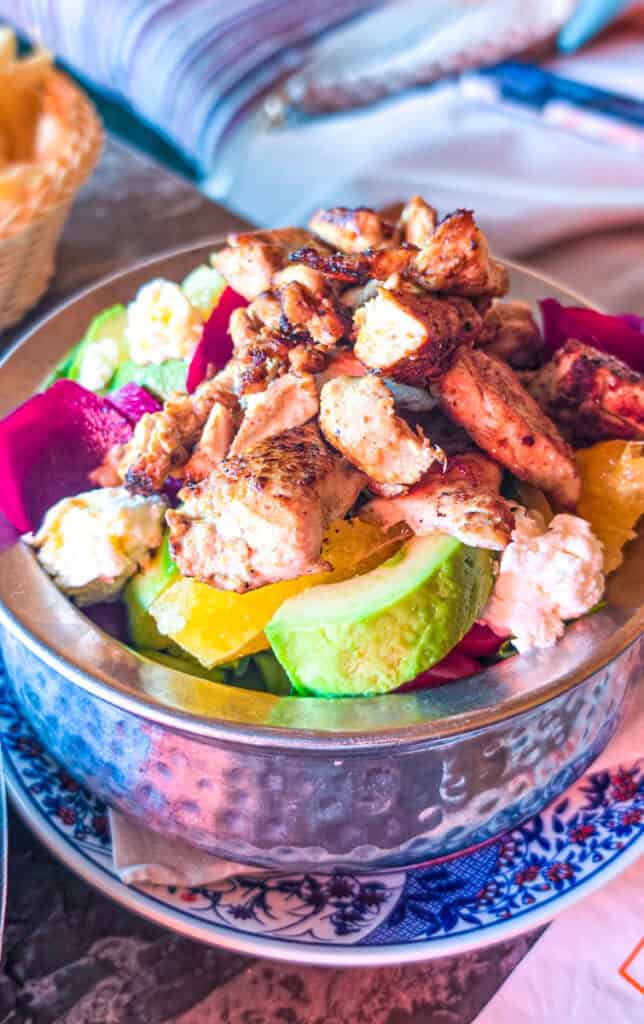
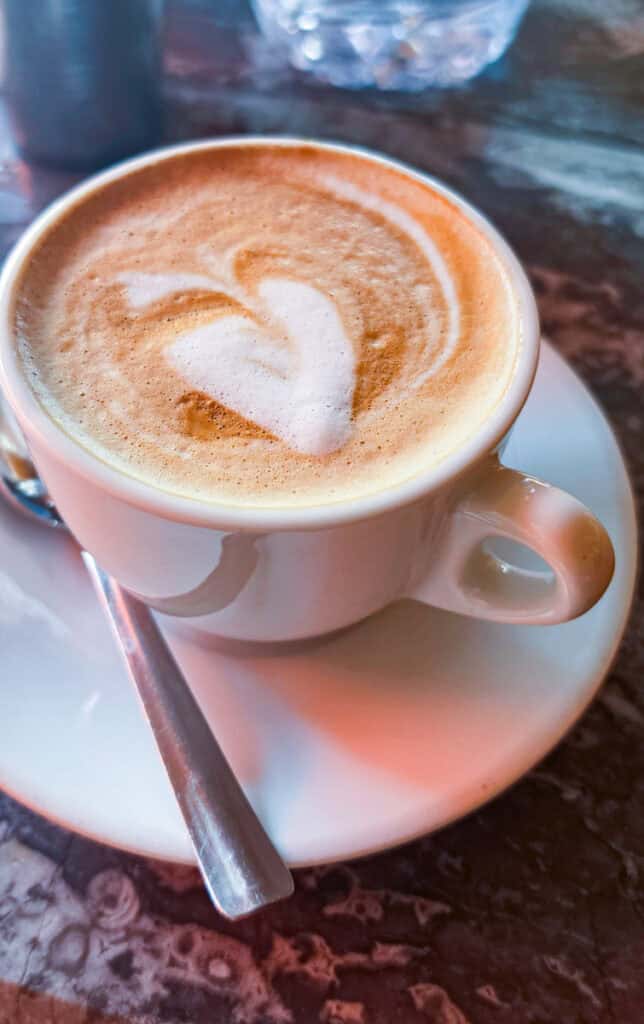
Allie, our trip photographer, and I took a table on the rooftop, which is full of little nooks and has a view of a minaret. (We only discovered on the way out that there’s a small private terrace one more level up, so climb all the way.) The menu is traditional Moroccan food with a modern twist, and we over-ordered because everything sounded good: sweet potato fries, a big fresh salad for Allie, a lamb tagine and a bowl of fries for me, and a ginger and lemon juice I would still love the recipe for. The coffee was so good that we stayed for a second cup.
Where to eat in Fes
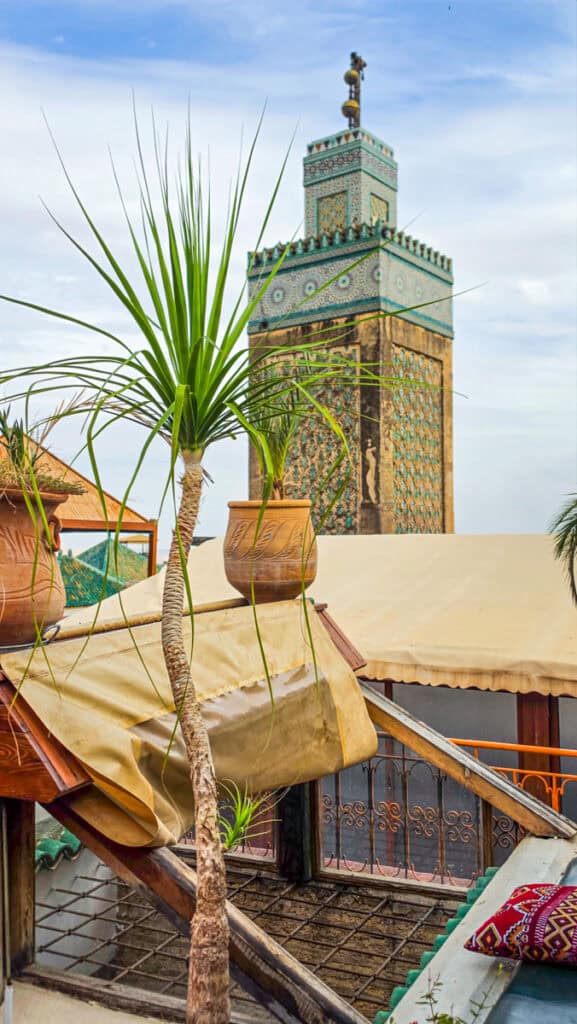
The best thing about eating in Fes is the surprise. Again and again, we walked through an unremarkable door in a dim alley, expecting very little, and stepped into a grand room with high ceilings and beautiful decoration. Most of our meals outside Marrakech were set menus, which seems common for tourists, and gluten-free was easy everywhere, as long as we gave notice. Café Clock (above) was our favorite, and these were the others.
Restaurant Ryad Nejjarine
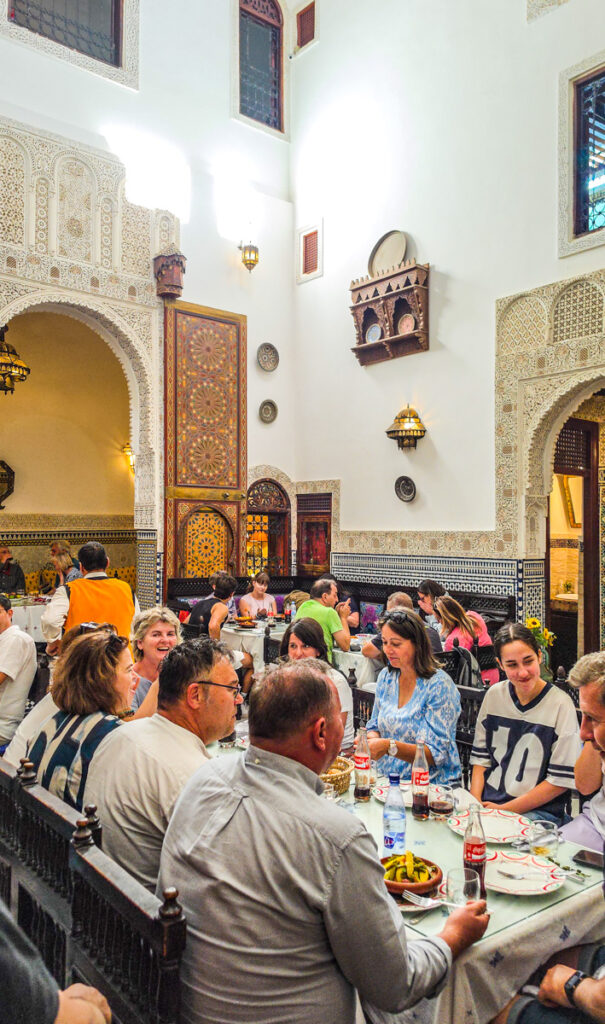
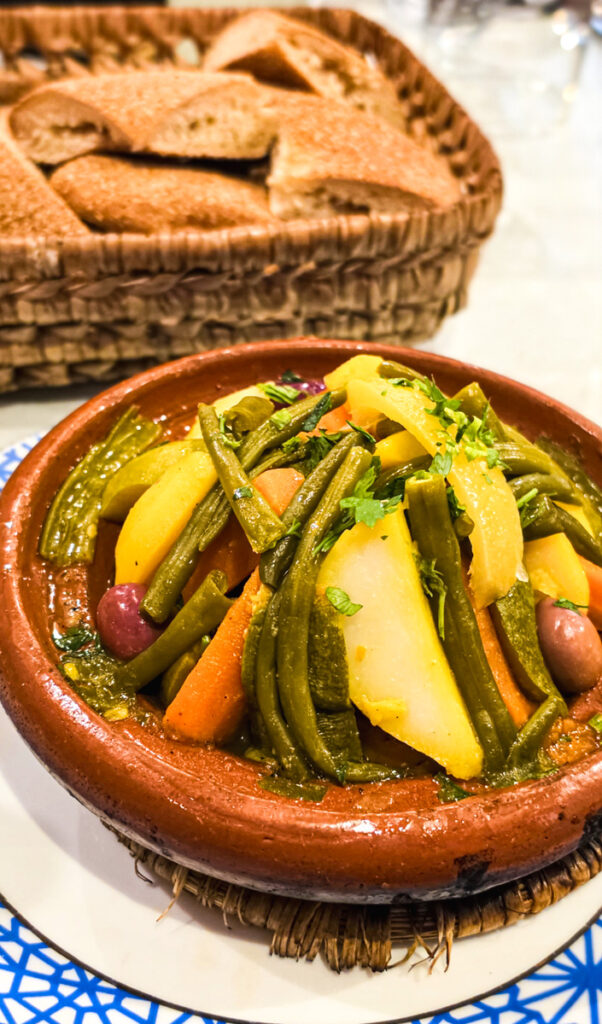
Restaurant Ryad Nejjarine, at 9 Rue Dermami in the Nejjarine quarter of the medina, was one of our favorite lunches of the whole trip. From the alley you’d never guess it’s there, and then the corridor opens into a soaring room packed with diners. The service was fun, the set menu started with a table of Moroccan salads (we couldn’t stop eating the baba ghanoush and the potatoes), and my tagine was beautifully cooked.
Their card machine wasn’t working when we went, and they insisted on cash I didn’t have, so Mo had to sort it out for us. Carry enough dirhams to cover a meal, just in case.
Restaurant Ouliya
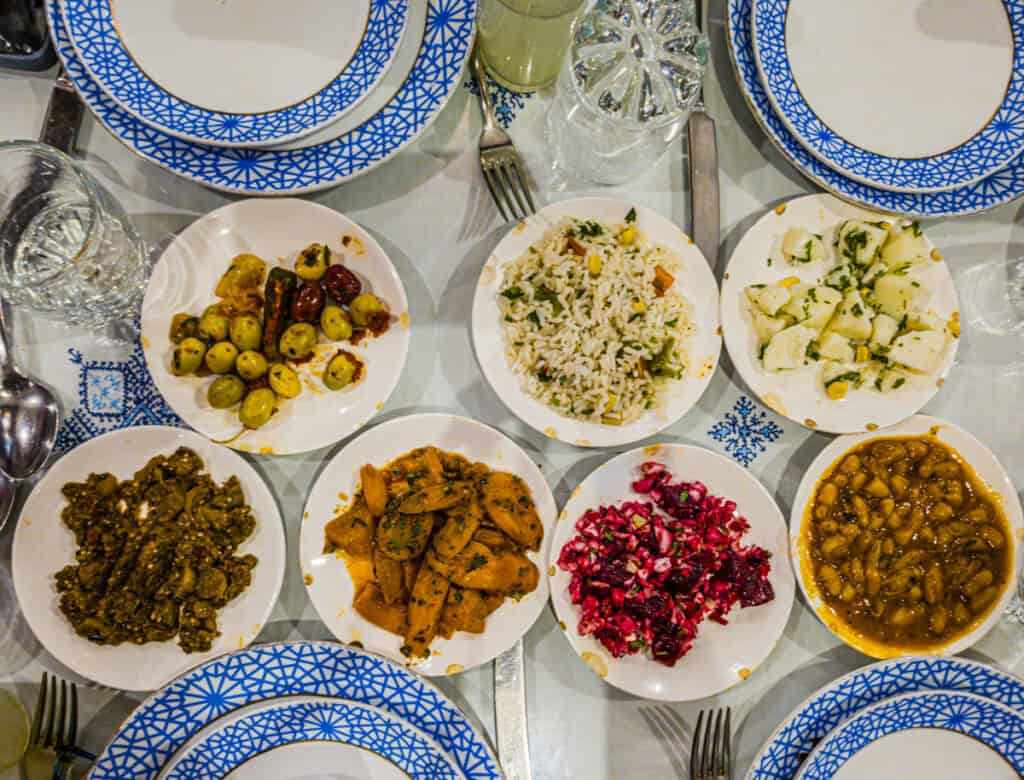
Restaurant Ouliya is the family-run restaurant inside Riad Ouliya, in Fes el-Bali near Place R’cif, and it’s where we ate on our first night. The staff were sweet with us, the three-course set menu included a shared Moroccan salad and a tagine, and the rooftop had wonderful night views over the city.
A quick note on Moroccan salad, since you’ll see it everywhere. It’s a collection of small plates of cooked vegetables, such as carrots, potatoes and eggplant dip, set in the middle of the table to share, and it was often my favorite part of a meal.
Mouda Palace
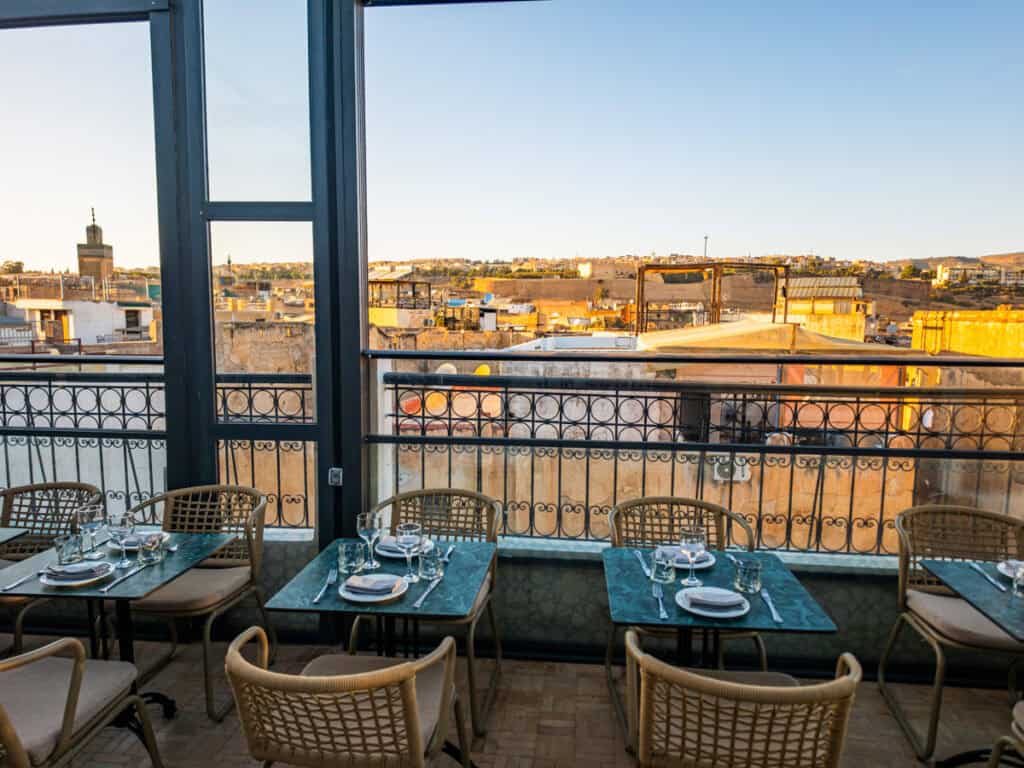
We only had drinks at Mouda Palace, but the rooftop views are lovely and the menu looked terrific, so I’d go back for dinner. It’s one of the few places in the medina where we found cocktails and Moroccan wine.
Dinner at Dar Victoria
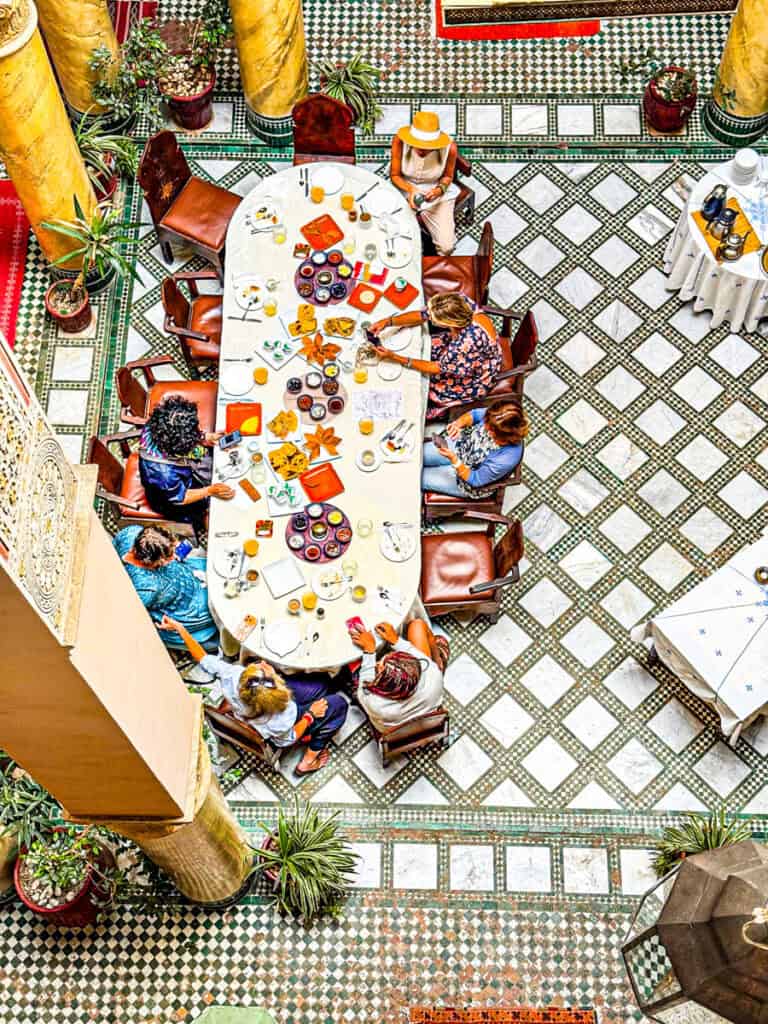
On our first full night we ate in at our riad, Dar Victoria, which served a three-course set menu. After a day of walking and getting lost, eating at home with the group and swapping stories from our free afternoon was exactly what we needed.
Where to stay in Fes: Dar Victoria
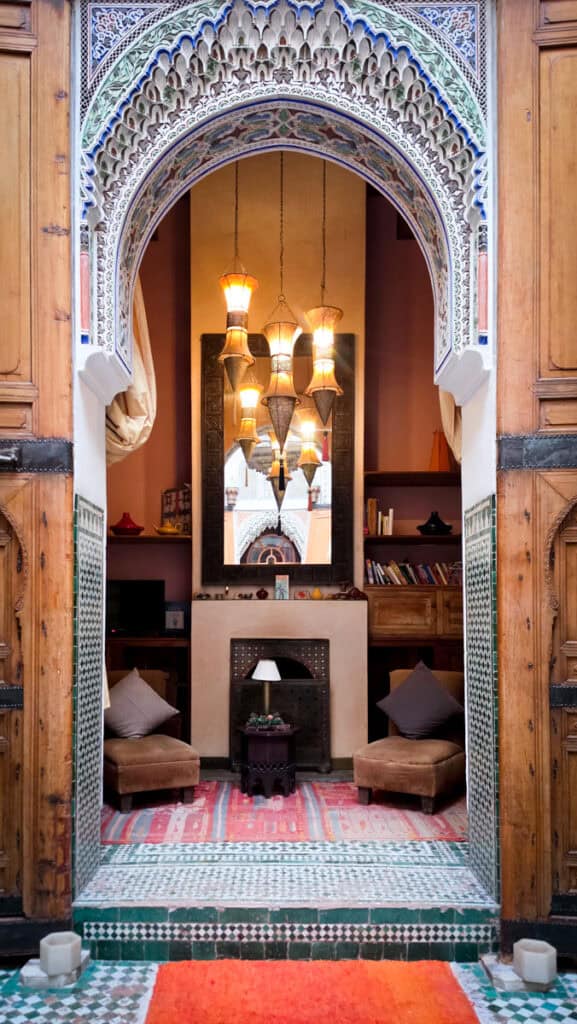
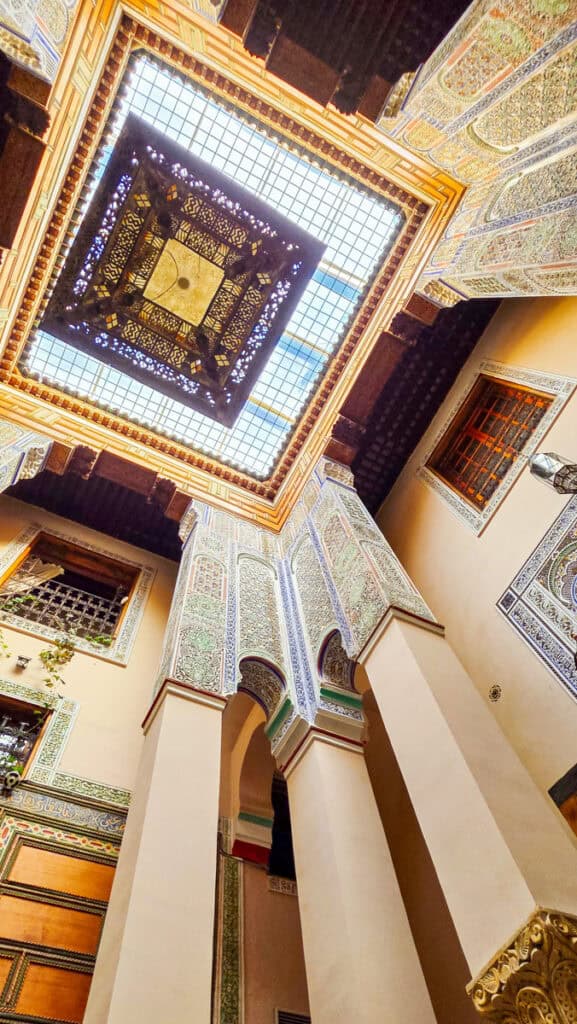
We stayed three nights at Dar Victoria, a boutique riad in an 18th-century family house, and I’d book it again. It was late when we checked in after the long drive from the desert (and dinner on Restaurant Ouliya’s rooftop), and the staff carried every one of our bags up to our rooms without a single sigh.
The house is built over several floors around a tall central courtyard, and no two rooms are the same. Two of the women landed the room on the roof and felt like they had their own penthouse, and Ali, another woman in our group and I shared a two-story room. For a group, or for friends traveling together, that mix of layouts is a real plus.
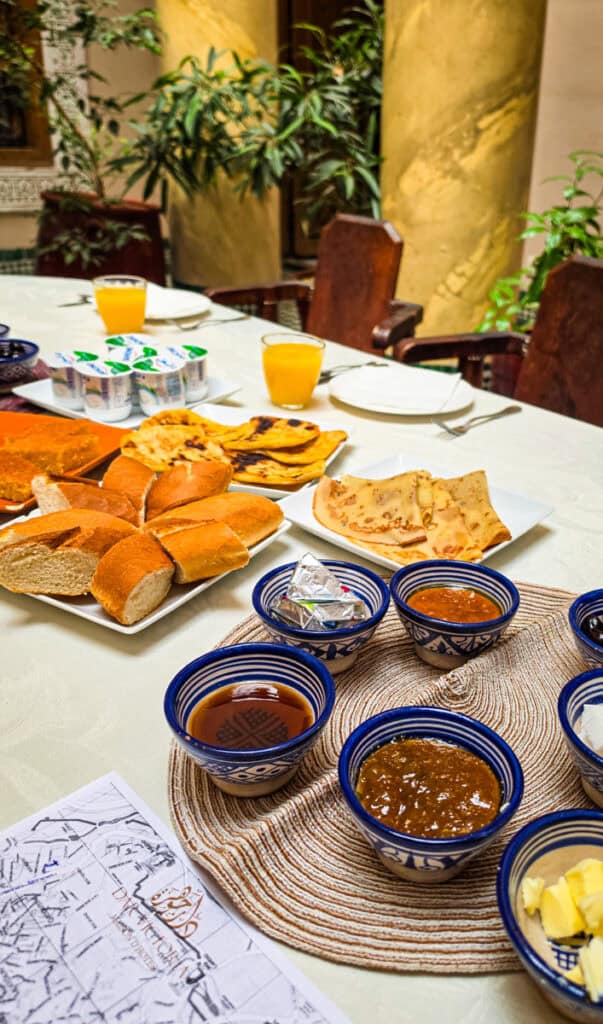
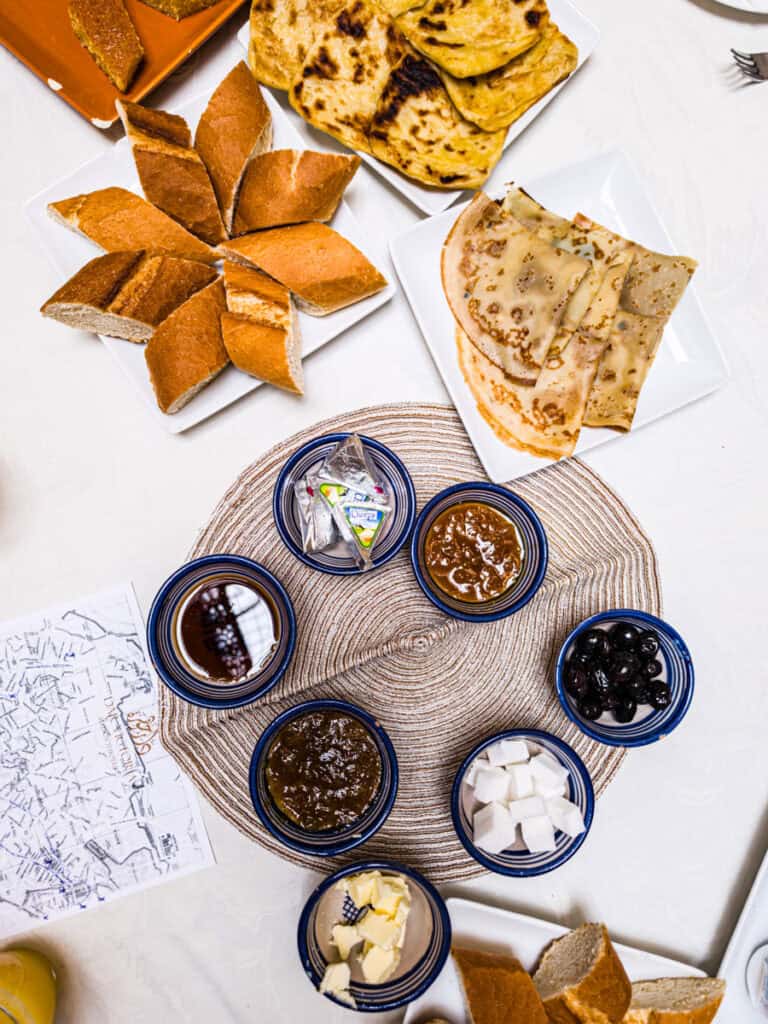
Breakfast was the best we had in any riad, and all the women agreed. They made me a Spanish omelet, set out the usual Moroccan spread of yogurts, breads, jams and spreads, and gave me rice cakes in place of bread for gluten-free (an odd swap at first, but with jam on top I was a convert). On our last morning, they put out a full breakfast very early, boiled eggs and all, before our drive to Casablanca, and carried our bags down again. Dar Victoria also has a small spa, which we didn’t have time to try, and it allowed us to bring our own wine to dinner for a corkage fee.
Why stay just outside the Fes medina walls
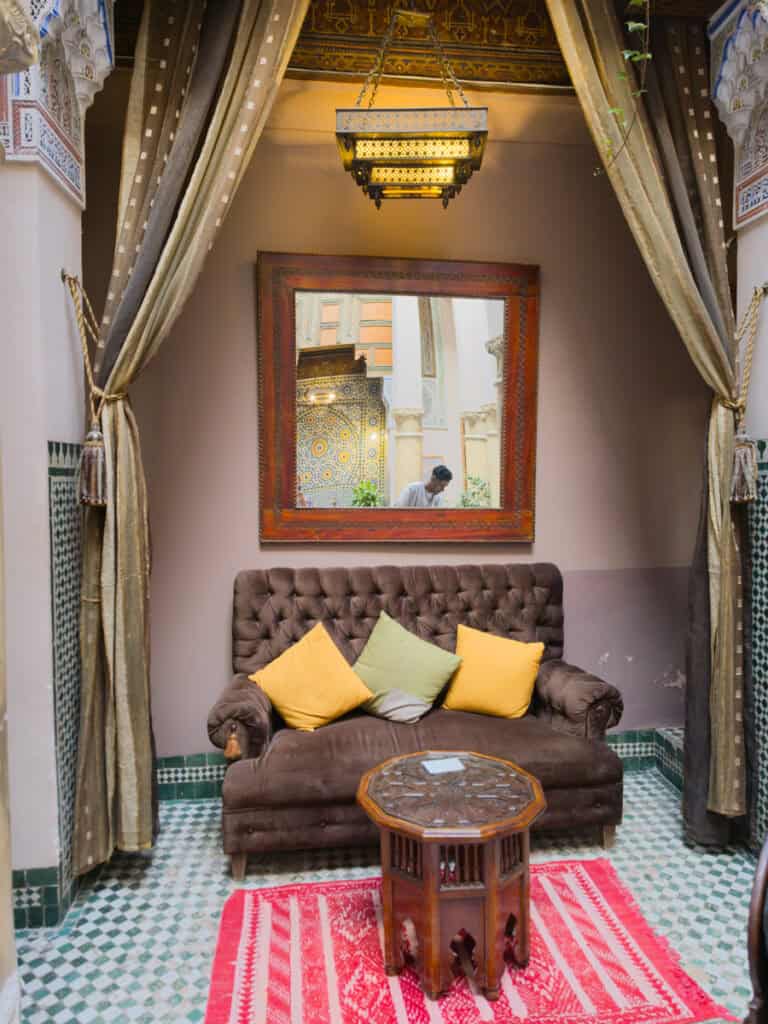
Dar Victoria sits just outside the medina walls. We’d step out the door, cross the road and walk straight into the old city, which made Fes so much easier for a group. Taxis could get close, so we could ride to the blue gate in the morning or get home quickly when we were running late, and the medina was still an easy walk away when we wanted to wander.
That matters more in Fes than in most cities. The lanes are so tangled that a riad buried deep inside the medina can be hard to find again after dinner, especially on your first night. Staying just outside the walls, close to a gate where taxis stop, gives you the medina on your doorstep and a quick way out when your feet are done. See rates and availability at Dar Victoria.
Fes vs Marrakech: which should you visit?
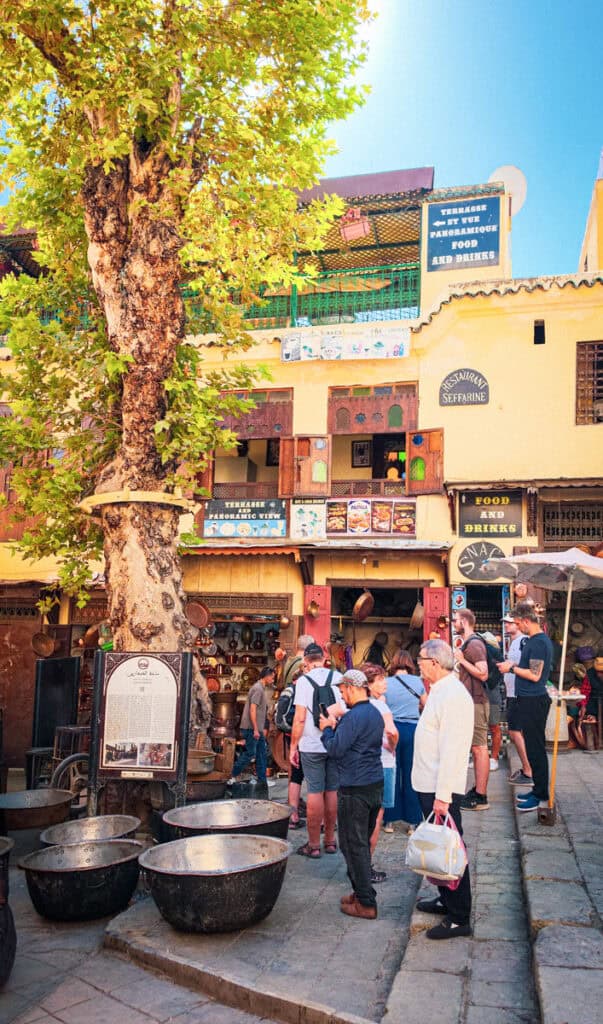
If you can, visit both, because they’re very different cities. I loved them both and can’t pick a favorite, but they suit different moods. I asked a good friend of mine this same question as we discussed our respective trips of Morocco. “You know, I can’t pick one over the other. They were both so different and I liked them both a lot.”
Marrakech is easier to find your way around. The souks are more open, with market stalls lining most lanes, and Jemaa el-Fnaa square works like a compass, since every lane eventually leads you back to it. It’s louder and busier, with the night food stalls and a newer district, Gueliz, to explore outside the walls.
Fes is older, quieter in its back lanes and far more of a maze, with high walls, fewer landmarks and many lanes with no shops at all. It’s the city for ceramics, leather and crafts you can watch being made, and it rewards slow wandering. If you only have time for one, choose Marrakech for energy and ease, and choose Fes for history and the feeling of having the medina to yourself now and then.
Planning the Marrakech side? Start with our 3-day Marrakech itinerary, browse the best things to do in Marrakech, and book a night street food tour in Marrakech with a local chef for your first evening. In between the two cities, don’t skip two nights at a Sahara desert camp.
Tips for visiting Fes
- Carry cash. Card machines failed on us twice in Morocco, including at lunch in Fes.
- Give notice for dietary needs. I’m gluten-free, and every server in Fes understood it. Riads and restaurants found alternatives when we told them ahead.
- Shop in Fes. It was the city I most regret not shopping in. Leave space in your suitcase, or buy a cheap bag in the souks for the way home.
- Dress comfortably and respectfully. Our guide told us to wear what we liked, and non-Muslims can’t enter mosques anyway, but see our guide to dressing modestly in conservative countries if you’d like to blend in.
- Say no to unofficial guides. It’s the most common scam you’ll meet. Our solo female travel safety tips cover more.
- Plan your exit. Fes to Casablanca airport is about three hours by road, so leave first thing if you have an afternoon flight.
- Allow two full days, or three. Two days covers the main sights, and I’d add a third to sit in the cafés and watch medina life go by.
Common questions about things to do in Fes
How many days do you need in Fes?
Two full days (three nights) is enough to see the main sights of the Fes medina, including Bab Bou Jeloud, Al-Qarawiyyin and the Chouara tannery, with time for a ceramics or cooking class. A third day lets you slow down and explore at your own pace.
Is it Fes or Fez?
Both are correct. Fes is closer to the Arabic and French spellings (Fās and Fès), and Fez is the spelling you’ll often see in English, so you’ll see both on maps, menus and signs.
Can non-Muslims visit Al-Qarawiyyin?
Non-Muslims can’t enter the mosque at Al-Qarawiyyin, but you can look through the open gates into the courtyard for free. It’s in the heart of Fes el-Bali, so you’ll likely pass it while exploring the souks.
Can you drink alcohol in Fes?
Yes, but only at a limited number of licensed bars, hotels and restaurants, and many medina restaurants don’t serve it. We had cocktails and Moroccan wine on the rooftop at Mouda Palace, and our riad, Dar Victoria, let us bring our own wine for a corkage fee.
Is the Fes medina safe?
I felt safe in the Fes medina in October 2026, even when I was lost on my own in empty lanes, though it can feel daunting. The most common problem we met was a scam by an unofficial guide, so decline anyone who offers to lead you somewhere and ask a shopkeeper for directions instead.
Come wander the world with me
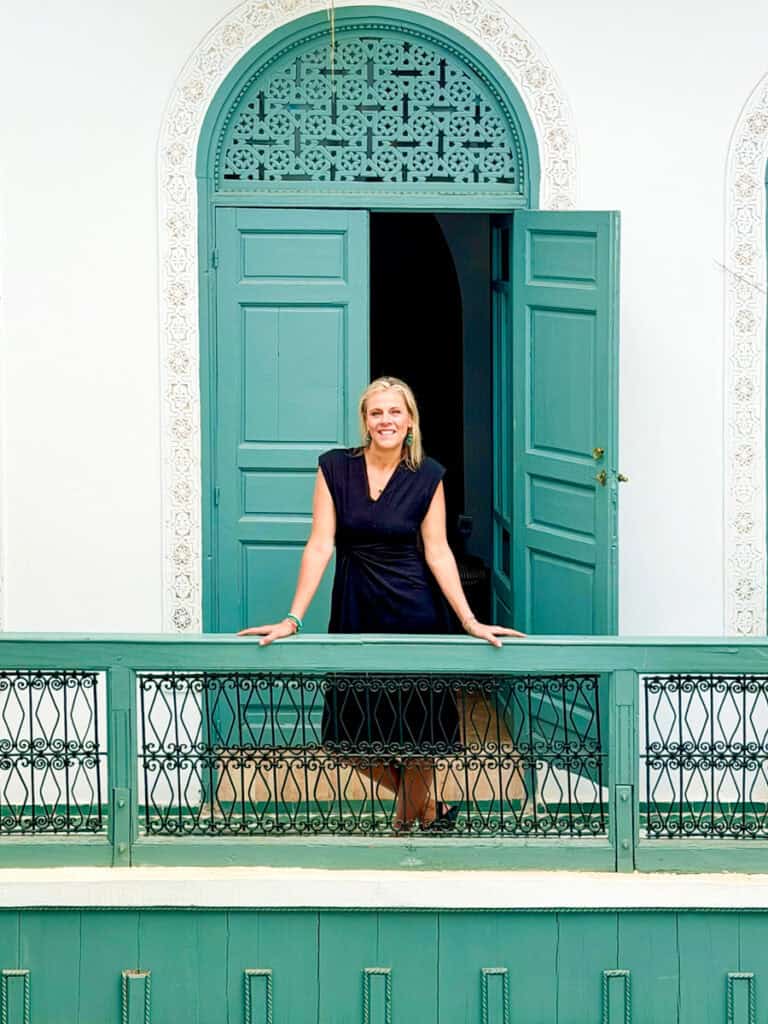
Fes kept surprising me, behind every plain door and around every wrong turn, and I left wishing I’d had one more day to sit and watch it all go by. If you’ve been, tell me in the comments what you’d add to this list, and if you’re planning a trip with a group of women, I’m leading Your Limitless Adventures trips to Thailand and Vietnam in early 2027. I’d love to have you along.
For more stories like this one, from Morocco and everywhere else we wander, join The Golden Thread, my weekly newsletter.
Original Article on yTravel Blog