

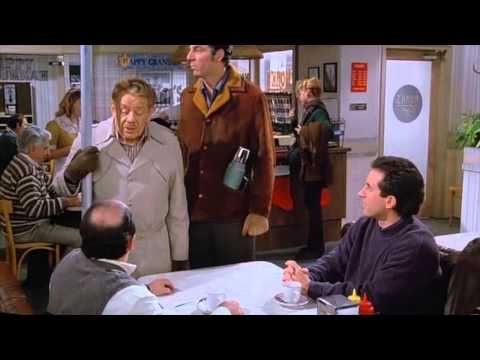
It feels like a scene straight out of Seinfeld, the way Dan O’Keefe explains his Festivus “outing.” The moment in 1997 when the esoteric holiday left the closed confines of the television writer’s memories of an atypical adolescence and slipped into the world via Hollywood producers took place as he was cornered in a booth with his colleagues prodding him to spill the beans. Over the next several decades, Festivus would morph and expand into today’s top alternative to Christmas. But in that moment, as Seinfeld’s four principal protagonists were often positioned, O’Keefe was seated with these successful writers and producers at a popular L.A. diner — though here, Swingers on Beverly Boulevard stood in for Tom’s Diner, the Upper West Side eatery the great sitcom put on the map.
Asked to join them at Swingers on a Saturday afternoon — the Seinfeld writing team was happy to work weekends — O’Keefe spoke with producers Jeff Schaffer and Alec Berg, who broke the news: his brother, Mark, also a television writer at NewsRadio at the time, had recently blabbed at a Christmas party about “this holiday” that the O’Keefe family celebrated, “but don’t like to talk about,” he’s said. Not only was O’Keefe brought to Swingers to talk about it, but Jerry Seinfeld wanted it for a story on the show.
“So, we kind of had this informal agreement, my two brothers and I, to not talk about [Festivus], because it was just weirding people out and depressing them. Because the reality was so fucking strange. And I guess he forgot, or didn’t care, ” O’Keefe told The Hollywood Reporter this week. “I was in no hurry to use pieces of my fucking weird childhood in television.”
Combined with story elements the Seinfeld writer had in his back pocket, the uniquely weird holiday that dotted his childhood, which would suddenly emerge on random days over the years at his father’s behest, became an “E” story of the 10th episode of the ninth and final season of history’s greatest sitcom. “The Strike,” in classic Seinfeld fashion, gives each player a distinct storyline: Jerry dates a sometimes-pretty-sometimes-not woman; Kramer works again at a bagel shop; George dodges Christmas gift-buying with fake donations to The Human Fund; Elaine hunts down a man she fake phone numbered to get her sub club card back. The “E” story in “The Strike” went to George’s father, the mercurial Frank Costanza, who was celebrating Festivus, the Dec. 23 holiday he concocted.
On Seinfeld, the lore goes that Frank created the holiday out of frustration and bloodlust while Christmas shopping years ago. He was at a store, reaching to buy a doll for his son, when another man reached for the same gift. In “The Strike,” Frank tells Kramer, “As I rained blows upon him, I realized there had to be another way…out of that, a new holiday was born, a Festivus for the rest of us.” For the new holiday, a traditional Christmas tree is swapped for a long pole (no decorations as Frank finds tinsel distracting). Instead of yule tidings and good cheer, at the Festivus dinner, one gathers their family around to tell them “all the ways they have disappointed you over the past year.”
If this feels esoteric and strange for a holiday born out of the rejection of the commercialization of Christmas, the true reality of Festivus at the O’Keefe family household may make you squirm. Elements, particularly the airing of grievances, were very much rooted in the unique holiday created by Daniel O’Keefe, a Ph.D and author who would ambush his three children with Festivus — it was typically around the holidays that the Festivus gathering could be expected, but not always. Once it was in the summer, for no reason. Another year, there were two of them. Sometimes it was on a weekend. Sometimes, the O’Keefe kids would get off the school bus to find their dad playing strange Italian pop songs from the 1940s, candles lit across the room. For O’Keefe and his brothers, it was always a surprise and never mentioned to friends, at school, anywhere. Songs of the Irish Republican Army, a rusty alarm clock placed inside a bag and nailed to a wall, and feats of strength competitions were all up the boozy patriarch’s sleeve — all of this was likely too much for the Seinfeld audience.
“When I described the reality of the holiday to [Seinfeld’s producers], they were like, ‘OK, yeah, you’re right. That is…sad,” O’Keefe recalled. “We’re not going to do the more fun version. Frank Costanza is a little like your father. They all met, but we’re going to make it a little more accessible.”
O’Keefe script, credited also to Schaffer, ran long and he was resting easy, convinced that the embarrassing E story would be cut in editing; this is how he reconciled himself to putting this piece of family weirdness on television and out into the world. Yet it made it through the editing process — despite the episode running 13 minutes longer than the roughly 22 minutes allotted for a sitcom. O’Keefe says the magic trick the editors pulled off to get all five stories in was one of the single greatest acts of editing he’s ever seen. On Dec. 17, 1997, Festivus took flight.
Daniel Lawrence O’Keefe was born in 1928 and grew up in the Greenville Ward of Jersey City. Educated at Columbia University, he was the first one in his family to attend college. In fact, he was one of the first to finish high school. After his Ivy League education, he was personally recruited by DeWitt Wallace, founder of Reader’s Digest. Later, in his career, the man described by his son as a “1959s L wrote a 1000-plus page tome, Stolen Lightning: The Social Theory of Magic; it details a unified field theory arguing that superstitions are the result of the decay of defunct religions. O’Keefe explains that his dad’s work is big in Japan, where the book found major popularity, but “outside of there, nobody reads that anymore.” At least he doesn’t think so.
“He was a brilliant, complicated, tormented, weird, extremely funny, charismatic, terrifying, probably undiagnosed bipolar guy — maybe with narcissistic personality disorder, or what I’m told is called histrionic personality disorder. He has a lot of disorders going on, but did the best he could with the tools he was given, as they say,” he told THR. “And one of the tools he tried to give us was made-up holidays, and Festivus is one of them.”
O’Keefe, it may be clear, is no Frank Costanza, and Festivus did not involve any dolls or assaults on fellow doll-seekers. O’Keefe the elder founded Festivus in 1966 to commemorate his first date with his wife, Deborah. Over the years, many of the elements of the conceived holiday are pulled from the early days of the couple’s relationship, according to his son. From there, Festivus evolved, just as it evolves today.
“The mission statement for the holiday was that it was about family. Originally, it metastasized out of some anniversary of his first date with my mom. I think they celebrated, I believe, I don’t know for sure. And then he thought that Christmas had become commercialized. He also had a complicated relationship with it because he hated the Catholic Church. He told me the Pope was a cocksucker before I knew who the Pope was or what a cock sucker was.”
When “The Strike” aired on Dec. 17, 1997, it received favorable reviews and solid-but-not-rapturous audience feedback. Festivus itself didn’t make too big of an initial cultural impact; audiences seemed to respond to The Human Fund gag, as the idea of donations on someone’s behalf as a gift had just caught on and was pissing gift receivers off. Seinfeld ended the following May and soon went to TBS on syndication, airing several times per day and earning new, younger fans. Then the entire series went to Netflix in 2021 for a reported $500 million. And as the audience grew, so did Festivus’ awareness. Today, Dec. 23, functions as an alternative to the pressures of a Christmas season so commercialized that it’s become a secular shopping event akin to Amazon Prime Day.
While the scale of Festivus celebrations and adoption in 2025 is difficult to gauge, as it takes place in private homes, the internet offers some clues about how popular the esoteric holiday has become. This year, a Yankees fan is airing his grievances with the team, and Congressional hawk Rand Paul has released his 11th annual Festivus report on “wasted” tax dollars, and “Festivus” is a trending term across the web, along with “Epstein” and “Christmas Eve Eve.” It wasn’t until around 2005 that the growth of the Festivus caught O’Keefe’s eye.
While Daniel O’Keefe the elder died over a decade ago at the age of 84, he did live long enough to see Festivus catch fire following the airing of “The Strike.” In fact, the success and large adoption of his concepts seem to have made all of his efforts to provide his boys with a holiday the family could call its own, whether they liked it or not, worthwhile.
“When I told him [about the episode], he was weirded out and alarmed and kind of ashamed. Then it came out, and people were OK with it, and he kind of equated: ‘Oh, well, I got away with something,’, he said. Then people started getting into it, and he was insufferably smug. He thought this retroactively justified every poor decision he’d ever made.”
As for Dan O’Keefe the younger, he eventually wrote the Festivus book, begrudgingly, it seems, after he saw that several third parties were doing the same (“If someone is gonna trample the corpse of my childhood like grapes to create wine, that is money in a very tortured metaphor. It’s gonna be fucking me.”). And if the opportunity were to arise, if Festivus were to grow to dizzying new heights, in his storage sits the ultimate Festivus archive: recordings of several years of the original Festivus events at his childhood home. He insists that it remains something to which no man should remotely want to subject himself. And that includes his child, who he says will not follow the family Festivus tradition.
“He thinks it’s odd. He’s never seen it and has no interest in seeing the episode,” he says, and indicates his son seems to grasp the essence of Festivus already. “He thinks it’s kind of both a little embarrassing and a little cool, depending on the week.”
Original Article on Hollywood Reporter